

About Will James

The Artists

Shop
Claggett/Rey Gallery is proud to present a special group exhibition and sale honoring the 100th anniversary of Will James’ first book, Cowboys North and South.
Will James
(1892–1942)

Will and Alice James, Washoe Valley cabin ca. 1923. Mountain West Digital Library, Digital Public Library of America. University of Nevada, Reno Libraries Digital Collections. UNRS-P2270-20
Born in a remote village of the Province of Quebec, Will James is a French Canadian whose birth name was Joseph Ernest Nephtali Dufault. As a youth he longed to become a cowboy. In 1907, at the age of 15, he left home to live his dream in Western Canada. Even way back then James was always drawing his favorite subject, cowboys and horses anywhere there was something to draw on. After working on farms and ranches in Saskatchewan and Alberta until about 1910, he appears to have become involved in a dispute with the law. The then Ernest Dufault changed his name to William Roderick James and drifted permanently to the United States. He began to capture wild horses for profit and work as a hand for cattle outfits in Montana, Idaho and Nevada. Arrested for cattle rustling, he served 18 months in Nevada State prison from 1914 to 1916.
While in prison he had time to work on his drawings, he was admired for his work and was urged to become an artist.
Several months after his release, while breaking wild horses for a ranch company south of Carson City, Nevada he suffered a severe kick in the jaw by a bronc. He now needed dental work and was told the best Dentists were in Los Angeles, California. While in LA getting dental repairs, he joined the famous Clarence (Fat) Joes Stable late in 1916, becoming a movie stuntman specializing in daring horse action.
Drafted into the Army during World War I, James served as a mounted scout with the 21rst Infantry Regiment along the California - Mexican border. His discharge in 1919 brought him American citizenship. He returned to his cowboy lifestyle but received a near fatal head injury after being thrown by a wild horse just outside of Reno, Nevada.
-
In 1919 he determined he would give up cowboy life and become a professional artist. In San Francisco he quickly gained success with Sunset Magazine and was first published in January 1920.
James married Alice Conradt in 1920. During these first years as an artist James struggled to make a living and eventually was helped by three well known artists; Maynard Dixon, Harold Schmidt and Charles Dana Gibson, then the editor of Life Magazine.
Finally, in 1923 he combined his talent for drawing cow country action scenes with a superb ability to express himself in the writing style of cowboy vernacular. On speculation, he mailed a short story illustrated with eight drawings to Scribner’s magazine. Four editors rejected the text as “too cowboy” for the magazine, but the art director, J.H. Chapin, prevailed upon Charles Scribner 11 to overrule them. He agreed and the resulting article was well received by readers and critics.
There after Scribner’s probably the most important publisher in American at the time, sought James’ work and he soon had other houses after his stories as well. Scribner’s in 1924 began to publish his stories into books which had instant success again among readers and literary critics.
Scribner’s editor encouraged James to write novels. He did so with his third book, Smoky the Cowhorse, and went on to set the standard for his day. He gained wide approval and fame over the next two decades and saw his books translated into six foreign languages. Will James had twenty-four books published by Scribner before his death in 1942.
In 1991 Will James was inducted into the Nevada Writers Hall of Fame. His third published book, Smoky the Cowhorse, won the coveted Newberry Medal for Children’s Literature in 1927. This book was made into three movie’s and in 1933 the film Smoky the Cowhorse and the novel won the Lewis Carroll Shelf Award, given by the University of Wisconsin 1065.
Will James was living and writing in a cottage on the Godshall Ranch in Victorville, California when he passed away on September 3, 1942.
Biography courtesy of the Will James Society
The Artists
Click below to go directly to any of the renowned artist featured in Cowboys North and South
Jay Adcock Bill Anton Wayne Baize Joe Beeler Teal Blake Ed Borein Sophy Brown Tom Browning Shawn Cameron Mike Capron Wilson Capron Todd Connor Bob Coronato Tyler Crow Glenn Dean Jane DeDecker Jay Dusard Josh Elliott Phil Epp Deborah Fellows Bruce Greene Brad Greenwood Martin Grelle Scott Hardy Linda Hayden Bo Joe TD Kelsey Matt Litz Rich Loffler Robert Lougheed Pablo Lozano William Matthews Herb Mignery Joe Milazzo Paul Moore John Moyers Terri Kelly Moyers Tyler Murphy Bill Nebeker Scott O’Farrell Julie Oriet Joel Ostlind Bill Owen Pedro Pedrini Noe Perez Scott Tallman Powers Maximo Prado Clark Kelley Price Robert Pummill Grant Redden Jim Rey James Reynolds Javier Ribeyrol Cary Schwarz Jason Scull Tim Shinabarger Cathy Smith Chuck Stormes Ezra Tucker Barbara Van Cleve Don Weller Rygh Westby John Willemsma Stewart Williamson Kathy Wipfler
For more information, or to acquire a piece from Cowboys North and South, please call the gallery at 970-476-9350
Click below to expand the full list of artists that have contributed to Cowboys North and South. Click an artist’s name to go directly to their work.
For more information, or to acquire a piece from Cowboys North and South, please call the gallery at 970-476-9350
-
Jay AdcockBill AntonWayne BaizeJoe BeelerTeal BlakeEd BoreinSophy BrownTom BrowningShawn CameronMike CapronWilson CapronTodd ConnorBob CoronatoTyler CrowGlenn DeanJane DeDeckerJay DusardJosh ElliottPhil EppDeborah FellowsBruce GreeneBrad GreenwoodMartin GrelleScott HardyLinda HaydenBo JoeTD KelseyMatt LitzRich LofflerRobert LougheedPablo LozanoWilliam MatthewsHerb MigneryJoe MilazzoPaul MooreJohn MoyersTerri Kelly MoyersTyler MurphyBill NebekerScott O’FarrellJulie OrietJoel OstlindBill OwenPedro PedriniNoe PerezScott Tallman PowersMaximo PradoClark Kelley PriceRobert PummillGrant ReddenJim ReyJames ReynoldsJavier RibeyrolCary SchwarzJason ScullTim ShinabargerCathy SmithChuck StormesEzra TuckerBarbara Van CleveDon WellerRygh WestbyJohn WillemsmaStewart WilliamsonKathy Wipfler
Jay Adcock

Jay Adcock grew up amongst a ranching family in Oklahoma. He was inspired by his grandfather to work with rawhide and leather at an early age. He spent some time with Oregon rawhide braider Frank Hansen and honed his craft while working on various ranches across the Western United States. Adcock went through the Texas Christian University Ranch Management Program in 1992 and was awarded the Academy of Western Artists Braider of the Year Award in 2006. He braids rawhide full time and lives with his daughter Ella on a cow-calf operation outside of Pawhuska, Oklahoma. He also has a son, Hayden, who resides in Butte, Montana.
20 Strand 5/8" Hackamore
Mecate by Sara Hagel
Laced Figure Eight Hobbles
Bill Anton

When the influence of your creativity is nurtured by the artistic prowess of James Reynolds, Ned Jacob and Michael Lynch your bound to display a giant stride in the stroke of your brush and layers of your paint to produce cultivated works of art. Bill Anton strives to elevate the level of his artwork through the tutelage of these great minds and continually soaks in the knowledge of his peers. His passion for the west; be it a sweeping mountain vista or the kinetic energy of life on a ranch, speaks thoughtfully from the end of the brush with each stroke he lays on the canvas. These words define the story behind each painting Bill brings to his audience.
"I do not see myself as a biographer of the "cowboy." I know some artists feel they are recording a historical portrayal of ranch life today in the American West. But the focus of my work has always been mood and passion. If I'm recording anything, I'm recording how I feel about the West. I want the viewer to feel the drama of atmosphere and the mystery of a western night. I want the volume and portent of a cloud to be evident in the calligraphy of a brush stroke. The pack of the muscle below a horse's shoulder should be energized by the gestural application of paint.”
Canyon Trail
18"×24" | Oil
Wayne Baize

Wayne Baize’s deep love of the horse plays a major part in his everyday existence and that respect reveals itself in each painting he creates. Depicting the modern cowboy’s daily life and rituals from the chaos of cattle roundups to contemplative scouts assessing the environment of the range, his inspiration rides in the saddle with him. Hailing from a small livestock ranch in West Texas, Baize lives his truth. His paintings are a testament to the enduring spirit of the American frontier, capturing the beauty and majesty of the ranching life. A man of the west, through and through.
Hot Pursuit
9.5"×22.5" | Pen and ink
Joe Beeler
(1931–2006)

Joe Beeler grew up in the Osage country of the Missouri-Oklahoma borderland like a young Huck Finn on horseback. With a pedigree that traces to a proud people enriched by Cherokee blood, he learned early how to rope, ride and hunt, and soon developed a knack for drawing cowboys, Indians and horses. He filled his head and heart with tales of old-timers, with his own adventures of horses and cattle, and with the vivid impressions of the swirling color and excitement of Quapaw powwows.
After a stint in Korea with Uncle Sam, Beeler met and married Sharon McPherson in the summer of 1956. He earned a degree in fine art from Kansas State College, and then went on to California for further study at the Art Center School in Los Angeles. Back in Osage country after just a year out West, the Beelers settled in a small rural cabin where Joe struggled to paint for a living with time off daily to shoot something for supper.
-
Tough times measure a man's mettle. Beeler painted neighboring ranchers' prize bulls and horses, and worked tirelessly on more meaningful pieces in the tradition of his hero, Charlie Russell. Recognition came slow, but it came, and in 1961 the Beelers left the Oklahoma hills for the red rocks of Sedona, Arizona. With new country and fresh inspiration, Beeler's talent quickened to a gallop.
In the almost 40 years since, Beeler has earned his place in the vanguard of the contemporary Western art movement, with one-man exhibitions at every major Western art museum venue and as a founding member of the Cowboy Artists of America.
The faces in Joe Beeler's paintings and sculptures shine with the wonder of Western life. Their eyes look both within and without, searching for and capturing the soul of the land.
Spring Roundup
30"×70" | Oil
Waiting for the Remuda
22"×8"×8" | Bronze
Buckaroo
16"×7"×6" | Bronze
Monday Morning
28"×9"×16" | Bronze
Never Walk When You Can Ride
12"×20"×8" | Bronze
Brandin’ Time
20"×16" | Oil
Teal Blake

Hailing from the eastern ridges of Montana’s Rocky Mountains, Teal Blake was surrounded by a quintessential view of ranching life. His family history runs deep with a rooted pulse of the rodeo, quarter horses and the daily routines of a cowboy. The visual whispers of influence decorated the walls of his father’s studio with western folklore from like of Charlie Russell to Will James. With his surroundings and background, it is not a wonder that Teal started putting the characters that filled his daily life on paper eventually tinting the personalities with watercolors and oils. Pillars of inspiration beckoned from the chaos of the corral, riding hell bent before an approaching storm or trailering the horses to head on the circuit: all these organic circumstances are captured in his work. A true man of the saddle.
Fannin’ the Stetson
6"×9" | Watercolor on original 1900 ledger paper
Stock Inspector
11"×8" | Watercolor on original 1908 ledger paper
Sun & Dust
10"×8" | Oil
Ed Borein
(1872–1945)

Edward Borein was an American etcher and painter from California. His artwork depicted Spanish Colonial California, the Old West, and Mexico.
Borein was born in 1872 in San Leandro, California. His maternal grandfather was "one of the most famous horsemen in Alta California", and his father worked for the sheriff of Alameda County.
Borein grew up as a vaquero on the Jesus Maria Rancho (later known as Camp Cooke). He studied art in New York City, where he became friends with Will Rogers, and in Paris. He was primarily trained as an illustrator.
-
Borein began his career as a cowboy in the 1893. He worked on the land for two decades.
Borein became an etcher and a painter, and he opened a studio in El Paseo, Santa Barbara, California, in 1921. He also taught etching at the Santa Barbara School of the Arts. His works of art were nostalgic artistic representations of the Western lifestyle. He depicted scenes of Spanish Colonial California, including Spanish missions. Another theme was the Old West, especially Native Americans and cowboys. His work was part of the painting event in the art competition at the 1932 Summer Olympics.
Borein maintained his friendship with Will Rogers, and he became friends with Charles Marion Russell, an Old West painter from Montana. According to The Los Angeles Times, "The three formed a triumvirate who depicted with picture and legend the West before the days of the fences."
Scratchin’ High
8"×5" | Etching
Sophy Brown

Fever pitched close ups of chaos and serene moments of contemplation drape the canvas’ of Sophy Brown’s work. Her kinship with horses inspires the foundation of her creative prowess. She describes this relationship with this quote: “Imagine an alarmed horse with wild eyes and head held high. His haunches are bunched, his feet are already moving underneath him and every fiber is poised for an action yet to be decided upon. That moment shivers with alert readiness is something we recognize in our blood, and bone. Using the horse as a subject, these paintings attempt to evoke an emotional recognition. Horses are instinctive in a physical way; they stand securely in their unique place in nature and speak to me on a visceral level and can remind us of our own animal skin. For me I can see all of life looking at horses, their responses and their relationships with each other, with people and their environment.”
Patrons are drawn to her pure—raw portrayal of life from her deepest understanding and perspective. You can’t help being drawn in.
The Cremello
28.5"×28.5" | Acrylic
Chico Basin Roper 1
12.5"×10" | Watercolor
Chico Basin Roper 2
9"×12" | Watercolor
Tom Browning

“I didn’t choose art as a career, it chose me” is the answer often given by Tom Browning whenever asked why he decided to become and artist. Tom began drawing horses, wildlife and Indians at the age of seven, and after five decades of painting and studying the work of Charlie Russel, James Reynolds, Haddon Sunblom Browning never tires of finding exciting ways to express this subject matter with the colorful and fluid brushwork that distinguish his place in the Western art market.
Wranglin’
18"×15" | Oil
Shawn Cameron
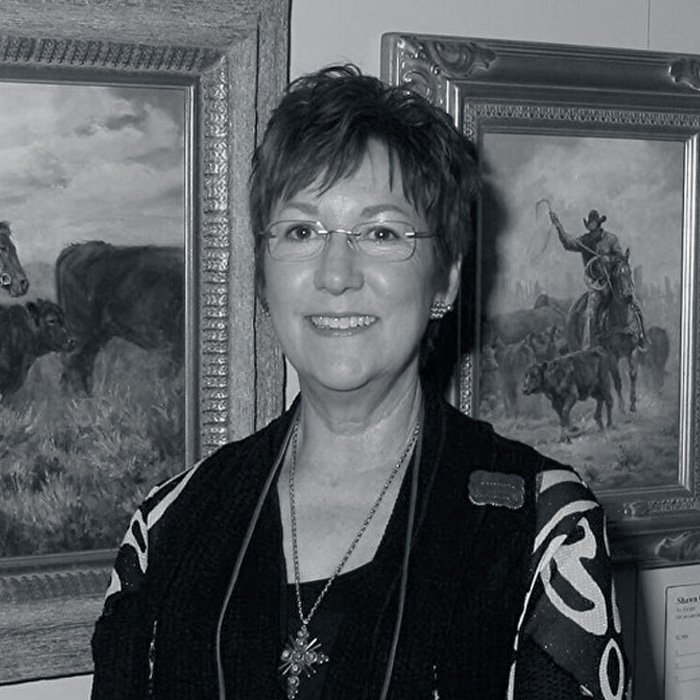
“My paintings portray the cowboy and ranch life I’ve personally known. My motivation is the nobility of these horseback men, my medium is canvas and a brush and by God’s grace I accomplish what is set before me.”
Learning is a life-long passion, and the art world is an infinite resource. Although primarily self-taught, the mentoring of several prominent western artists helped her work grow and evolve into a career that has spanned three decades. She remains grateful to all but especially Bill Owen, for generously sharing his knowledge in many areas, for Joe Beeler whose continued encouragement and support meant so much and to Robert "Shoofly" Shufelt who opened a door to the world of professional art.
-
"Will James was in our home growing up...he and I traveled many trails together after we became acquainted while reading "Smoky the Cowhorse" when I was young. As a child, I owned a small half Mustang, half Morgan horse named Coco and instantly fell deeply in love with Smoky. In my mind, I knew and understood him well. Will was my companion on many days and the pages of his books were usually open. He made the viewer feel they were part of the West and fully present in any scene described or story he told. As I grew and matured into a professional artist, that became my goal as a painter...to allow the observer to relive the scenes I'd experienced...just as Will James did. I want those looking at my art to know what it's like horseback as the sun prepares to rise...searching the landscape for cattle and cowboys. Will James' skill at bringing the reader into the story was a major motivation to me as a painter...and the reason I remain loyal portraying the subject matter my family has lived for generations. I paint with much gratitude and respect to the man that revered that life as much as I do."Description text goes here
Chamisa Moon
24"×20" | Oil
-
"On Arizona's northern plateau ranch mornings usually begin before sunrise. The western sky is occasionally viewed as brilliant colors layered just the horizon...often highlighted by the setting moon. I've watched cowboys in the fall, garbed in worn leather chaps, riding through blooming chamisa unaware of the predawn sky's display of light and color. They are intent and purposeful, seemingly oblivious to the magic displayed. The show is brief for once the sun rises the multiple hues melt into a dusty blue/green that dominates the day. The cowboy in this piece is our son, Brooks, who is focused on gathering and moving his cattle toward the shipping corrals...as did three generations on this ranch before him."
— Shawn Cameron
Mike Capron

I have always been fascinated by these three things: ridin’, ropin’, and paintin’. I find many things similar in these three art forms. The challenges are always present in all three. Nobody rides every horse, nobody catches every cow, and nobody makes a masterpiece every time. I am satisfied to concentrate on the art form of painting, drawing and sculpture at the present. Sharpening the fundamentals of draftsmanship, composition, values of form, color studies of Chihuahuan light, paint quality, perspective, anatomy and proportions are something that will keep me busy through this lifetime. I love the problems of creating a picture that someone can relate to and feel connected to. This is a means of communications that has been around since the first cave wall artist. Expressing oneself is always a challenge, but it can be hopeless if you don’t have anything to say.
Shootin’ the Breeze on Company Time
16"×22" | Oil
There Goes my Favorite Red Dress
30"×40" | Oil
Wilson Capron

Wilson Capron takes high relief sculpted engraving to a whole new level with his attention to finite details folded into each curve and surface of his work. In each piece he is offering up a part of his heart and soul, telling his story of the west. Since 1997 Wilson has chiseled away precious metals to reveal elegant nuances in his bits, spurs with unique ornamentation. His knowledge in metallurgy is unparalleled, forging together the strength of steel, the regalbrilliance of gold and sleek reflections of silver bringing them together to form these equine works of art. Knowing first-hand the utility and function of these necessary pieces of equipment to lead a horse through daily chores, Wilson takes particular care to make all the moving parts uniquely convey the message from rider to horse as clear and gentle as possible. With this kind of attention to detail on both ends of the spectrum, owning a piece of Capron’s is a true bridge between a ranching team.
TCAA 2023 “Howling at the Moon” Spurs
Sterling silver and 14K gold
-
Growing up there wasn’t anything that scared me anymore than hearing a close coyote sing their song. Each one has a different tune that could send me under the covers in a ball. Today their howling creates a different emotion in me. It represents a resilience and determination to survive regardless of the changes the environment offers. The coyote is a survivor and adapts to whatever is going on around them. One of my favorite animals without question. I sculpted the coyote in 14k gold with relief engraved sterling silver overlays surrounding it. The rowels have fine silver inlays on curved tines representing the ever-changing journey that we all travel.
Todd Connor

Todd Connor a native of Tulsa, Oklahoma, has lived and painted in Montana for most of his professional career. His love of the outdoors grew from a childhood spent camping, hunting and fishing. At the age of twelve he started painting in pastels and oils. His subject matter ranged from landscapes to fish, wildlife and western themes.
After high school, Todd took time off from painting and joined the Navy where he served as a Navy SEAL in Coronado, California, and overseas. After the Navy he traveled the country visiting historical sites and National Parks where his love of history and the outdoors came together with his desire to pick up the paint brush once again.
-
Todd received a BFA in Illustration from the prestigious Art Center College of Design in Pasadena, CA in 1997. After graduation he worked as a colorboard painter for Universal Studios Japan theme park project. In 1999, Todd made the move to Montana, painting full time, where he has met with much success. A near sell out show in Bozeman in 2000 set his career in motion and he never looked back.
Pop Goes the Stirrup
18"×24" | Oil
Bob Coronato

“I used to open books and look at the “Old West” photos and see cowboys riding the open plains, and I would stop and think, “I wished I lived 100 years ago.”
After going out to the very remote west, and finding ranches that still “cowboy” in the old ways, I realized that the west I was searching for as a kid, was still there.
In tiny hidden corners of our country, you can still find places untouched by time. There are ranches that gather on horseback 2000 to 3000 head of cows, across 100’s of miles of fenceless landscape. Hulett Wyoming is one of these hidden treasures. 20 years ago I attended Otis/Parsons Art institute in Los Angeles, and upon graduation, I moved to a town of 408 people called Hulett, to find the west I was looking for.
-
The time has come where land is becoming too valuable, and it is no longer affordable to have cows roaming free, on open range. This forces ranches to sell off lands to survive, and before long, the “West” will be gone. Even now I can see dramatic changes and the things I was lucky enough to be a part of just a few years ago, are now gone. For example, old style ranch rodeos, traditional brandings, log cabins with no electricity, and running the chuck wagon during roundup. I no longer have to wish to be a part of the old days, but have become part of the west I was searching for. We are at a clash of two times where traditional cowboy’n ways are being overridden by the modern technologies. This has been the focus of my paintings as I try to document moments in time that show the ways of a fading lifestyle that so many people have admired. The freedom of the west, and the wide open spaces have become a symbol of our great country. As our lives become more regimented, and the rules become more numerous, we long for those places of freedom.
The subjects of my work reminds people that there still is a remote, free west. It gives a sense of relief, that we are not a completely modern country, just yet. The questions I hear most often is, “Do they still do that?” Well….. yes they do, but not for much longer. By living in a very remote section of Wyoming, and working with ranchers and cowboys, I feel proud to have been lucky enough to be a part of this final chapter in the history of the American frontier. For now, “The West” is alive, it’s just hiding, in small corners of our country, trying desperately to hang on, and not be forgotten.”Description text goes here
Wild and Woolly:
It's dangerous at both ends and uncomfortable in the middle
12.75"×10.5" | Original chine collé etching
Tyler Crow

Tyler Crow will be the first to acknowledge the discovery and honing of his craft are credited to a long list of folks who took an interest in his artistic talent and subsequent career as a young adult, not the least of which is the “Good Lord Himself.”
Growing up between the farmland and foothills of Apache, Oklahoma, Tyler discovered his calling in art and developed his unique style. He continues a lifelong commitment to grow and improve in his artwork.
Taking his art from talent to trade has taken time and development, but Tyler found his subject matter long before he ever picked up a brush. Cowboy culture and western heritage were etched in Tyler’s youth, and he’s committed his artistic career to preserving the western way of life and the contemporary cowboys who live it every day.
-
Tyler is passionate about his pursuits, “I feel blessed to do something I love, and to paint the American cowboy.”
In 2016, at the age of 27, Tyler became the youngest artist to ever be inducted into the prestigious Cowboy Artists of America, where he’s already received awards and accolades.
Tyler lives in Hico, Texas, with his wife and son.
The Unexpected
16"×20" | Oil
Glenn Dean

Glenn Dean’s childhood interest in art matured into a love of painting landscapes by his early twenties. Exposure to the California and Western landscape painters of the early 1900’s had a great influence on the young artist, and directed the course of his career early on. In the works of such masters as Edgar Payne and Maynard Dixon, Dean saw the “importance of seeing the color of light” while “carefully observing the simple and basic characteristics of a specific location.”
Largely a self-taught Artist, Dean has a passion and joy for discovering answers to the complexities found in the works of those past masters and continues to strive for a similar quality in his own work. In recent years, Dean has turned his attention to the figure within the landscape as he brings the figure closer to the forefront. It is the relationship between the figure and his surroundings which intrigues Dean.
-
Dean gained recognition early in his career. He has twice been honored as the cover artist for Western Art Collector magazine, and has appeared in several national magazines including Western Art and Architecture, Art of the West, Southwest Art, and American Artist. Dean has won a number of awards including his most recent, the 2018 Henry Farny Award for Best Painting at the Eiteljorg Museum's Quest for the West Art Show and Sale. In 2017, Glenn won the Artist's Choice Award at Quest for the West, and in 2016, Glenn was the recipient of the Victor Higgins Award of Distinction for the Best Overall Body of Work. Select awards include: the Gold Thunderbird Award (Best of Show) at Maynard Dixon Country; the first ever Emerging Artist Award presented by Art and Antiques Magazine; and the Grand Prize and Artists' Choice Award at the inaugural Tucson/Sonoran Desert Museum Plein Air Invitational.
Dean paints on-location throughout the Southwest, dividing his time between deserts, mountains, and coastal subjects. Time in the field and in the studio are equally important to Dean. While working in his studio, Dean is able to paint larger compositions worked from field studies and other references. Dean and his wife, Suzanne, live in his native state of California on the Central Coast.
Taking the Old Trail
12"×9" | Oil
Jane DeDecker

Jane DeDecker has been making a major contribution to the world sculpture scene since 1986. Creating over 350 limited edition, original sculptures, 90 of those being life-size and 20 one-of-a-kind monuments, with multiple sold-out editions. She has been published in magazines reaching global circulations, from USA Today to Forbes Magazine. Jane DeDecker has hit her stride in honoring the historical significance of women’s achievements through sculptural form. Throughout her career, she has commemorated the accomplishments of over 35 trailblazers like Amelia Earhart, Emily Dickenson, Harriett Tubman, Ida B. Wells, Alice Paul, Susan B. Anthony, Sojourner Truth, Elizabeth Cady Stanton, Hellen Keller, and Laura Cornelius Kellogg — this list just scratches the surface of the league of women she has brought into her life and her studio. These women were there to bear witness and bear the burden of discrimination and doubt in their abilities because of their gender. Against insurmountable odds, these champions accomplished groundbreaking achievements. In 2021 Jane had over 15 sculptures of sentinel women (in various stages of completion) gracing her studio. And there is always room for more.
-
Cities and special interest groups across the nation have been commissioning Jane to capture and honor their local unsung heroine and icons. Until now, many of these women were merely forgotten and rarely mentioned but in footnotes. DeDecker’s latest commission debut is an homage to 4 giants in the civil rights movement titled “Ripples of Change” for Seneca Falls, NY. As described by Jane “Each of these women has their own individual connection to Seneca Falls as well as their unified dedication to women’s suffrage… “Each answers their own call to effect change, and yet their individual efforts merge into a coalesced movement that promotes, honors and expands the rights of women.” Her accolades in this category have led her to help pass a bill (HR-473) through the US Congress and Senate to have a monument placed in Washington DC that honors the women who fought for and eventually passed the 19th Amendment. Claggett/Rey Gallery is proud to represent Jane’s collection of historic women and if your community is ready to tell the story of a local legend, we can help you make that story come to fruition.Description text goes here
Tending the Spirit
8"×12"×5.5" | Bronze
Jay Dusard

Born in St. Louis in 1937, Jay Dusard was raised on a southern Illinois farm. As an architecture student at the University of Florida, a travel scholarship to study American architecture, coast to coast, was his introduction to the American West.
Dusard spent two years in the peacetime army, using his off-duty hours to "cowboy" near Fort Hood, Texas. In 1963, his cow punching led him to an Arizona-Sonora border ranch, where he found his best deal ever: "open country, independence, seven bucks a day, bunk and board."
In 1965, while living in Tucson, Arizona, and working in architecture and cartography, Dusard started photographing. A year later in Flagstaff he was working in publishing and regularly aiming his large-format cameras at the landscape. He met photographer Frederick Sommer, who became his mentor and paved the way for him to teach photography for seven years at Prescott College.
-
A 1981, Dusard was awarded a Guggenheim Fellowship which allowed him to pursue the working cowboy, buckaroo, and vaquero as a photographic subject. The resulting body of work was published in The North American Cowboy: A Portrait (1983). His second book, Open Country, was awarded third place in the 1994 Photographic Book of the Year competition. In 2005, he collaborated with writer Thomas McGuane on Horses. A documentary by Michael Markee, Jay Dusard: Keeping the West Western, premiered at the Sedona International Film Festival in 2006.
Dusard’s work has been exhibited at several public institutions among them, the Phoenix Art Museum, Glenbow Museum (Calgary), Colorado Springs Fine Arts Center, Consejo Mexicano de Fotografia (Mexico City), Art Museum of South Texas, and the International Photography Hall of Fame (Oklahoma City). His work is included in the permanent collections of the Center for Creative Photography at the University of Arizona, Tucson, the Tucson Museum of Art, the Phoenix Museum of Art, the Museum of South Texas, the Los Angeles County Museum of Art (LACMA), the Booth Museum of Western Art and the Charles M. Russell Museum, as well as several private and corporate collections.
Martin Black
38"×48" | Archival pigment print
Jim and Jason
20"×16" | Silver print
Bob Wroten
22"×22" | Archival pigment print
Jim and Connie Brooks
16"×20" | Silver print
Pole Corrals, Montana
11"×14" | Silver print
Oro Ranch
22"×28" | Archival pigment print
Josh Elliott

Josh Elliott was born in Great Falls, MT in 1973. He was raised to appreciate art and is a third generation artist. His grandfather studied with Grant Wood and dabbled in all sorts of artistic pursuits. His father, wildlife artist Steve Elliott, gave up a successful career as an ER doctor to become a full-time artist. Josh's father taught and encouraged him. Josh learned the importance of painting from life and discovered his passion for painting outdoors. He sees his outdoor paintings as a reaction to what is in front of him, and feels they act as exercise to sharpen his skills. He considers his studio paintings to be a culmination of everything he has learned from painting out, combined with his own artistic interpretation.
Born in Montana, Josh lived out of state for some time but always felt a deep connection with Montana's landscape and people. Josh now lives with his wife and two daughters in Helena, Montana.
-
He participates in many shows including: American Masters at Salmagundi Club in New York City, Maynard Dixon Country, Quest for the West at the Eiteljorg Museum, and Western Rendezvous of Art. Josh won the "Palette Award" at the 2008 Quest for the West show. He was awarded the "Edith Hamlin Award" at Maynard Dixon Country in 2007. Josh had a feature article in Southwest Art's February 2009 issue and was one of the artists in the magazine’s “20 Success Stories” article, he was also featured in Art of the West's spotlight on rising stars in the November/ December 2009 issue.
Modern Remnants of the Old West — Will James Country, North
12"×36" | Oil
Alkali
36"×48" | Oil
Summer’s Toil
30"×36" | Oil
Phil Epp

Phil Epp was born in York, Nebraska, in 1946 and raised in rural Nebraska on a crop/cattle farm. Phil says he is strongly imprinted into the open spaces of the Great Plains where he was born and have spent most of his life. His paintings reflect this celebration of open sky and landscape, with a hint of human occupation, and he strives to incorporate timeless universal icons into the landscape. A recent trip to the Kazakh Steppe in Central Asia reinforced his efforts at a universal dialog of the sparsely inhabited visual environments. He says his recent works attempt to place emphasis on content and subject over technique and medium, in an effort to better communicate with the viewer.
Phil was awarded the Kansas Governors Artist award in 1985. His paintings have been shown at galleries in New Mexico, Chicago, Kansas City and New York. Numerous monumental public works have been awarded honors, including 8 wonders of Kansas Art in 2009 and Water Tower of the Year in 2010. In 2009, Phil was selected as a U.S. cultural ambassador to Kazakhstan with the U.S. Department of States’ Art in Embassies program. His work has been displayed in American Embassies in Latvia, Africa and Fiji. In 2010 he received the Best of Show award at the Panhandle Plains Invitational in Canyon, Texas.
-
He recently completed three large paintings for Arrowhead Stadium, home of the Kansas City Chiefs. His induction into the Cowboy Artists of America is a monumental yet humbling honor and challenge. The wide-open spaces and the horses, cowboys, Native Americans and prairie creatures that inhabit this empty landscape have been a lifelong passion. Epp’s studio is based in Kansas and he continues to travel, photograph and paint wide-open western vistas.
Three in the Storm
20"×16" | Oil
9.5"×6.5" | Etching
6.5"×7.5"× | Etching
6.5"×7.5" | Etching
Deborah Fellows

Deborah Copenhaver was born and raised on a cattle and Quarter Horse ranch in northern Idaho.
Her father, a World Champion Bronc Rider, supported the family with his winnings. She and her younger brother Jeff grew up on the ranch, often alone with their mother. Work on the ranch was shared by all, and a life long passion for horses grew from those responsibilities. It was at this time that Deborah sold her first drawings of horses.
In the post-Vietnam era, Deborah won competitions to create veteran memorials, including the Inland Northwest Vietnam Veterans Memorial, Montana State Vietnam Veterans Memorial, and the Washington State Korean War Memorial.
-
She also received commissions to do monuments of Henry Kaiser, James Irvine, and Frank Erwin of the University of Texas and created a monument for The Boy Scouts Of America.
Deborah’s life and career have reached new heights in the last decade. In 2012, she won the competition and was commissioned by the state of Arizona to create a monumental bronze of Barry Goldwater for Statuary Hall in Washington, D.C. In 2016 Deborah created a monumental bust of William P Clark, California Superior Court Judge for Rancheros Visitadores in Santa Ynez, California. In 2017 San Antonia Sculpture Trail LLC commissioned a monumental sculpture of Jim Bowie for the Alamo in San Antonio, Texas.
Deborah has returned to her original inspiration source, the American West. Living now in southern Arizona with her husband, Fred Fellows, Deborah is devoted to creating fresh, original, and accomplished sculptures expressing her feelings for the Western way of life. Surrounded by splendid Southwestern scenery and a string of good horses, she has assured an ample source of inspiration for a lifetime.
She Rode Good Horses
15.5"×12"×8" | Bronze
Smoky’s First Friend:
You’re Nobody Till Some Bunny Loves You
7"×10"×4.5" | Bronze
Bruce Greene

Bruce Greene is one of the legitimate heirs to a cowboy kind of legacy that traces its beginnings back to Charlie Russell. It is a legacy that is tied hard and fast to a familiarity and feeling for ranch life reality and based on a bedrock of artistic accomplishment.
Way out in West Texas on the historic JA Ranch established by the patriarch of pioneer cowmen, Charles Goodnight, Bruce has discovered and tapped into a deep reservoir of cowboy reality and enough artistic inspiration to last him a lifetime.
Bruce has seen the sun come up between his horse’s ears on the backside of Palo Duro pasture, and it is his privileged perspective that enables him to show us, through his art, the authentic essence of the contemporary cowboy.
“There will come a time when the cowboys of today will look at Bruce Greene’s art and smile at the memory of the way their world once was.”
The Bell on Old Blue
54"×28"×11" | Bronze

Of Questionable Character
14"×11"×7" | Bronze
Brad Greenwood

Located in the beautiful Paradise Valley of Montana, north of Yellowstone National Park and just south of Livingston, you'll find the artist's studio filled with a menagerie of artifacts, tools, vintage parts, organic findings and wood … Lots of beautiful and exceptional hard woods.
Authenticity and tenacity, remnants of yesteryear, are alive and thriving here and now inside the workshop of J. Bradley Greenwood.
The artist's use of antique and modern mechanics, along with a refreshing measure of remarkable skill and originality, are all elements of the seemingly magical process that takes place within his creative space.
Greenwood's hand-hewn designs are a throwback to an era when quality craftsmanship was the measure of a products worth
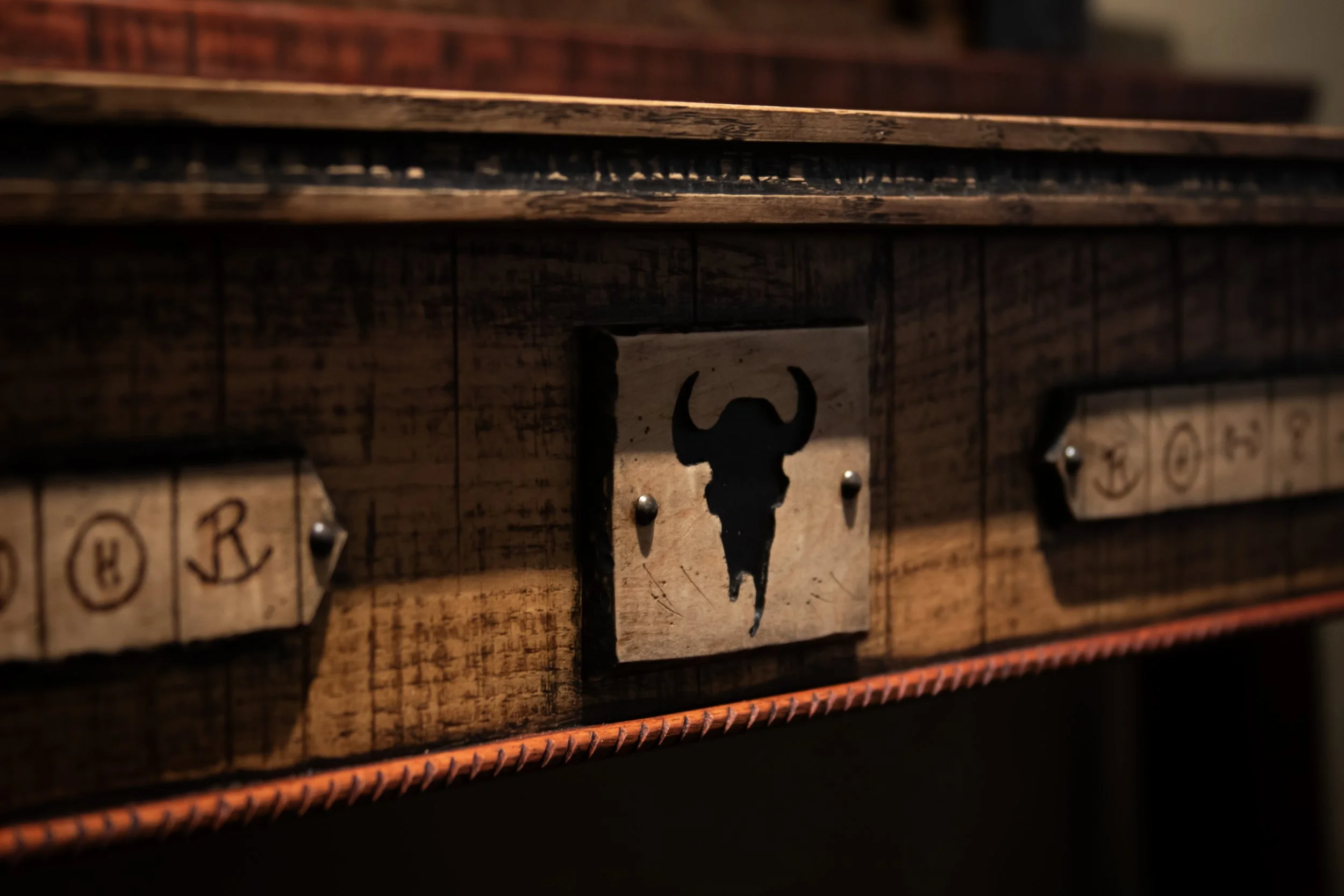
Lost Trails Entry Table
37"×57"×12.25" | Quarter-sawn white oak, locust, sycamore, steel, pistachio, black walnut, eucalyptus, maple, copper leaf inlay
Click below to expand details



-
In celebration of the 100th Anniversary of Will James’ first novel, Cowboys North and South, the artist has been invited to participate in a show and exhibition hosted by the distinguished Claggett/Rey Gallery. The “Cowboys North and South Show and Exhibition” will be displayed in the month of August 2024 in Edwards, CO.
The artist has created a commemorative art piece that is both stunning and pragmatic. An intricate carving of an expansive view of cow country and a worn cowpuncher, as described by James in his book, is an impressive focal point of the composition. Other fine features that delight the eye are the re-creation of the ranch brands the cowboy writer/illustrator rode for, along with his own ranch brand, the Rocking R.
Greenwood utilizes a striking array of hardwoods, repurposed steel, meticulous carvings, textured surfaces, and more throughout this notable piece. His work embodies the design perception, handcraftsmanship, and time-honored building techniques inherited from Old World artists. Every aspect provides significant beauty and durability that is able to withstand the test of time.
His standard of taste is long-lasting – His furniture, timeless.
Made in its entirety by the artist.
Martin Grelle

Born and raised in Clifton, Texas, Martin Grelle and his wife, Joyce, still live on a small ranch a few miles from town. His studio sits in the picturesque Meridian Creek Valley, surrounded by the oak and cedar-covered hills of Bosque County, just a short distance from his home, but also within a few miles of the family and friends who are so important in his life. He has two sons, Josh and Jordan, who have left home to pursue their own dreams. Grelle’s parents, Ervin and Ella, have both passed from this life, but he still has his brothers, Carl and Marvin, living nearby, as well as his sister, Mary, who lives in Fort Worth. Joyce’s three sons, Zach, Emitt and Carl, and their families are also close.
Grelle began drawing and painting when he was very young, and was fortunate to have James Boren & Melvin Warren, two professional artists and members of the prestigious Cowboy Artists of America, move to the area when he was still in high school, and it has had a lasting impact on his direction & career. Mentored by Boren, he had his first one-man show at a local gallery within a year of graduating from high school in 1973.
-
Since then, he has produced some 30 one-man exhibitions, including annual shows at Overland Gallery in Scottsdale, Arizona, from 1989 through 2014, and has won regional and national awards at shows around the country.
Beyond his studio, Martin teaches an annual weekend workshop along with his friend and fellow CA Bruce Greene—which they have done for 24 years straight—and mentors aspiring artists. He has donated work to a number of organizations to aid in their progress, including The Bosque Arts Center in Clifton.
He has twice served on the board of directors for the CA, as president for 2014, and as chairman of CAA 50th Anniversary Events in 2015.
o6 Morning
12"×12"× | Acrylic
Scott Hardy

There’s some spectacular mountain scenery outside Scott Hardy’s silversmithing studio, and he’s got big windows on all four sides to maximize the views and inspiration. To place you geographically, he’ll tell you it’s 45 miles south of Calgary, in the beautiful rolling foothills of the Canadian Rockies, by the little town of Longview. “If you’ve ever seen Open Range, Legends of the Fall, or Unforgiven, they were filmed right around here,” Hardy says. “I can trailer my horse and be in the mountains in 15 minutes. I ride a lot. I always have and always will.”
A fifth-generation stockman, Scott Hardy became a full-time Western silversmith in 1981 and, 17 years later, became a TCAA founding member. Hardy finds inspiration in nature, art, fine craftsmanship and the West itself. Using each of these to fuel his passion, Hardy celebrates the West through his artwork, inspiring craftspeople, artists and collectors alike to see the importance and relevance of the North American cowboy culture. “Embellishing horse and rider with precious metal is a tradition as old as man on horseback,” Hardy said, “and deserves the respect of being done by hand one piece at a time.”
Will James Bucking horse Buckle
Sterling silver with 14k rose and yellow gold overlays
For the Girls who Rode Wild Horses
Silver by Scott Hardy, Saddle by John Willemsma, Quirt by Pablo Lozano | $38,000
Honoring all the women who rode bucking horses in the early 1900’s in the early days of rodeo and Wild West shows.
Linda Hayden

Linda Hayden lives high above the Central San Joaquin Valley of California in the foothills of the Sierra. She and her husband, Joel, and son, Russ are cattle ranchers on the South Fork of the Kaweah River near the small community of Three Rivers, gateway to Sequoia National Park. It is here in this beautiful area that Linda collects the natural materials she uses to dye her handspun wool and create her all natural saddle blankets. Linda grew up in the Salinas Valley of California where she was greatly influenced by some of the best horsemen in California. Her interest and love of traditional horse gear started at an early age and with it came her desire to create saddle blankets similar to those of the Navajo Indian. She has been weaving for 46 years and this desire to weave the traditional wool saddle blankets has taken her to studies in Colorado and New Mexico where she concentrated on the Navajo and Rio Grande methods of weaving.
In 1994 Joel and Linda sold their ranch in the Salinas Valley and moved to Three Rivers. It was at this time that Linda started concentrated on showing her blankets in western art and gear shows. Since that time she has exhibited in Elko, Nevada, Sheridan and Cody Wyoming, Fort Worth, Texas, and numerous shows in California. She has customers through out the U.S., Denmark, England and Italy.
The Charlie Russell
-
This is my “Charlie Russell” blanket. He loved color as shown in the Métis sashes he wore, but the saddle blanket he painted and used on his own horses were often of simple design. He used red, black and brown often.
I handspun Navajo Churro wool and used the natural colors of the sheep except for the red, which was derived from the cochineal insect. This insect grows on cactus plants in Arizona, New Mexico and Texas and is prized for its beautiful colors.
This style of Blanket was often seen in Will James drawings and popular in the early 1900’s.
The Joe Beeler
-
This blanket design was inspired by a Joe Beeler painting. I handspun the Navajo Churro wool and dyed it with plants from my dye garden. The blue, grey and deep purple color were derived from indigo plants, the gold from marigold flowers. These plants are soaked for several days in large buckets of water then simmered for 1-2 hours over an open fire. After the plant color is leached out, the plant material is strained out, the wool is added to the pot and simmered for another hour. To get the dark purple-brown color, I added an iron horse show to the pot and simmered for another hour. The white, black and brown colors are the natural sheep colors.
The Joe De Yong
-
This red and white blanket was woven with extra thick Navajo Churro wool that I hand spun. The design was inspired by many Joe Beeler paintings. He used this similar design on horse blankets throughout his book depicting the popularity of this simple design among cowboys in the 1940’s and 50’s. It’s still a favorite today.
The red color comes from the roots of the madder plant which must be from for three years before the roots give this beautiful color.
The Will James
-
I had an overwhelming desire to use all three colors in this blanket after studying paintings by Frederic Remington and Charlie Russell paintings. They often used these colors in scenes depicting Indian fights, bar brawls and buffalo hunts. It seems they used wild colors to create action and excitement in their paintings.
All the colors in this 100% Navajo Churro wool blanket come from plants and grew in my dye garden or were collected on our ranch. Several reds came from the cochineal insect, lichen, madder roots and dahlia flowers. The many yellows came from goldenrod plants, marigold and coreopsis flowers. The blues are from indigo leaves and the light green from apple tree leaves. The brown color was derived from oak galls.
Bo Joe

Born in Shiprock, New Mexico Bo currently resides in Sheridan, Wyoming creating his jewelry directly from his studio.
After receiving the traditional techniques of tufa casting from his father Oreland Joe Sr. (renowned stone sculptor and painter), Bo Joe’s body of work represents a unique hybrid of cultural preservation combined with present day artistry.
Of Diné and Uté descent, Bo specializes in high grade turquoise while his range also includes diamonds, gold, and other precious metals and gems. He takes great pride in offering his clients a refined and personalized experience.
A Gift for Alice
Solid Sterling Silver Concho Buckle Set featuring 8 Cts. of Natural Lone Mountain Turquoise on a Tom Taylor leather belt
-
This Diné (Navajo) period piece is a nod to the environments surrounding Will James throughout his life and the woman behind the man, his wife Alice. Early on Alice believed Will’s natural storytelling abilities would translate well to print and she provided a steadfast supply of encouragement regarding his artistic talents.
It was said Will would bring home gifts for both Alice and her mother on occasion. His nomadic lifestyle found him in Kingman, Arizona and Santa Fe, New Mexico during a short period; this piece symbolizes the thought of a gift indicative of those cultures to bring home to his lovely wife.
The line work in this piece is hand stamped section by section, requiring patience and precision as would have been accomplished by the early Diné during that period of the 1920’s. The Lone Mountain turquoise is sourced from Nevada, the state where Will and Alice spent the first years of their marriage and delighted in Will’s early successes and Smoky. The flower motif featured on the middle belt loop is replicated from the same motif on Will James’ drawing chair from his first studio in Washoe Valley, Nevada. It was here Will James said he “left the trail of the range for the trail of art.”
T.D. Kesley

T.D. Kelsey grew up on a ranch near Bozeman, Montana. He rodeoed for many years in rough stock events and team roping. Following that, T.D. trained and showed his own cutting horses for several years. He worked as a commercial pilot for United Airlines until 1979 when he resigned to devote full time to his art.
His interest in, and promotion of, Texas longhorn cattle, maintenance of a wild horse herd on his ranch, passion for Africa and its wildlife, and concern for the conservation of wildlife worldwide have inspired many of his works. An avid traveler, he has visited many countries on every continent except Antarctica, drawing and sculpting people and animals from all corners of the world in addition to his western subjects. He is known for his intense, impressionistic sculptures that capture the spirit of his subjects.
No Place to Part Company
12"×18"×21.5" | Bronze
Matt Litz

A flat sheet of silver does not hold a lot of meaning for those with an untrained eye, but for silversmith Matt Litz, it is an opportunity to create a work of art designed in his mind and coaxed by his hands.
Silversmith is a craft dating back to as early as 4695 BC. Many of the same tools utilized by the very first silversmiths are still in use today including tongs, engraving burins, large scales, hammers, anvils, small mallets, ceramic furnaces, blowpipes with clay nozzles, and weights.
Growing up in a farming and ranching family, working with my hands has always been a way of life for me. I built my first buckle in 2004 and all I have wanted to do since is build more. I’ve had no formal training or instruction, I build what I see in my head and feel in my heart.
-
As a welder (full time) and a novice silversmith at night (in my spare time), I focus on creating the best pieces that I possibly can. Some of my creations are worn and used from the everyday cowboy to professional cowboys. Going to college and majoring in agriculture services gave me the persistence to set a goal and keep pushing until its reached. My goal is to be the best silversmith that I can be, and I will strive to become just that. Silversmithing isn’t just a hobby of mine, it’s a passion and an experience with every new project that I look forward to every time.
Champagne Flute Pair
8"H | Sterling silver
Rich Loffler

Richard Loffler grew up on the wide-open Saskatchewan prairies in central Canada. He became a committed outdoorsman as a teenager absorbing the wonders of the natural world around him. Many zoos became a retreat for observing animals in close quarters, while the Royal Saskatchewan Museum in Regina, where he began working from 1978 to 2000, was a haven to study the beautifully prepared natural history dioramas.
"I have been given nature's theatre to access freely. I find it a necessary tool in the formation of the idea and the finished work. Working from life affords me controlled confidence. No questions go unanswered.
-
Nature is a tremendous foundation from which to acquire knowledge and understanding: the fundamentals are what every artist must seek to recreate truthfully and innovatively. Through evolution, each animal has carved its' own original statement within this vast scheme of rhythm and structure. Their spirit and vitality offer a perpetual platform from which to learn. The complex web that nature weaves for us cannot be understood in one artist's lifetime; it is a forever growing and changing format and one that deserves distinction.
My approach is traditional with impressionistic flavor. I endeavor to capture the character of my subjects at moments of instinctive gestures while the lyrics of design and composition are controlled to present a power and grace to each piece. To work from nature allows me simply the truth and it affords me the ability to pursue my art as a life long venture, for the subjects are endless and timeless.”
Barnyard Politics
21.75"×63.5"×15" | Bronze
-
I have witnessed on some occasions the antics held within a barnyard setting where domestic animals parle with one another and get the rank figured out. I saw this small vignette play out where these turkeys followed this young colt to the grain pile each morning. I wasn’t sure of the why but I thought it quite cute. The design came easy and the personalities of each character followed there after.
— Rich Loffler
Bounty Hunter
21"×14"×18" | Bronze

The New Saddle
17"×28"×7" | Bronze
Robert Lougheed
(1910–1982)

Robert Lougheed was a Canada-born American artist who has specialized in images of the American West.
He was born and raised on a farm in Massey, Ontario, Canada. He became an illustrator for mail-order catalogues and for the Toronto Star, but studied in his spare time at the Ontario College of Art and then at the École des Beaux-Arts de Montréal. He went to New York City at the age of twenty-five as the pupil of Frank Vincent DuMond and Dean Cornwell at the Art Students League. However he continued to work as an illustrator for over 30 years and his work appeared in magazines such as National Geographic and Reader's Digest. Lougheed's work as a commercial artist included the Mobil Oil logo of the red flying horse.
He explored the American West, particularly the old Bell Ranch in New Mexico, and many of his paintings were inspired by the scenery and animals of the region. Consequently, in 1970, he was commissioned by the United States Post Office Department to design the six-cent buffalo stamp for their Wildlife Conservation Series.
-
Lougheed illustrated children's books such as the horse novels Mustang and San Domingo by Marguerite Henry and The Bell Ranch As I Knew It by George F. Ellis. He also illustrated books by Martha Downer Ellis, about the Bell Ranch, NM including Bell Ranch Sketches, Bell Ranch People and Places and Bell Ranch Recollections. He won multiple awards at both the National Academy of Western Art and the Cowboy Artists of America. Some of his work is in the Cowboy Hall of Fame in Oklahoma City, Oklahoma.
Robert Lougheed's interest in art extended to the founding of the National Academy of Art at the National Cowboy Hall of Fame. He continued to serve as an advisor to the academy for many years. He also worked voluntarily as a teacher to many young painters. Outside of art, Lougheed was an avid tournament badminton player who won a number of regional and Connecticut state doubles titles.
In December 2007, the Lougheed Studio at Claggett/Rey Gallery opened in Vail, Colorado. The Studio is devoted to the life and legacy of Robert Lougheed. In January 2010, Robert Lougheed: Follow the Sun was published, chronicling the life and career of the artist.
Action at Indian Rock
25"×30" | Oil
Casey Tibbs
8"×13" | Watercolor
Pablo Lozano

Born in Buenos Aires, Pablo Lozano’s family tradition is tied to Argentina’s cattle heritage. At age 15 he began studying rawhide braiding with his mentor, the late Don Luis Alberto Flores. A career rawhide braider, Lozano believes in the concept of apprenticeship as a means to educate and preserve traditional arts. He has been awarded Best of Show several times at the Sociedad Rural Argentina and is a member of their panel of judges. Lozano frequently participates in braiding seminars and workshops in the United States and was awarded the 2015 Braider of the Year by the Academy of Western Artists.
“Ring” Hobbles
-
Lozano combines functional designs, excellent craftsmanship and his own techniques to fabricate this functional sets of rawhide hobbles.
The robust softened rawhide hobbles were fabricated with Shorthorn hide from Lozano’s ranch. The rawhide is double and features an imbedded rawhide stitching inside for durability and to protect the horse’s hide. The outside features a high relief stitching.
The centerpiece incorporates a metal ring inlaid with silver, designed and fabricated by Bit & Spur Maker Ernie Marsh. In the back of the ring areengraved the names “PABLO LOZANO” and “E.MARSH” and “TCA 2022.”
The metal ring is secured in place between the softened cowhide and the braided rawhide. The French grey finish of the metal ring serves as a frame and contrast with the central Gaucho button, and one Gaucho button on each side. The 8-plat round braid and fancy button closure ensures the hobbles strength and functionality.
“Let-Loose” Hobbles
-
This “let-loose” hobbles were created with one piece of “softened cowhide” folded and stitched with rawhide for strength and secured in the center by a rawhide bride and overlaid by three gaucho buttons. The two strands of twisted rawhide forms the slot or “eye” and in the opposite end secure a hardwood peg with fine rawhide buttons which closes the hobble. The twisted rawhide cords merge in the top where they are laced with rawhide and secured with a button.
The concept is to run a rein or mecate through the slot and release the hobbles by pulling after the rider is securely mounted. Lozano combines the functional design, easy use and excellent craftsmanship of traditional hobbles and utilized his own technique and artistic license to fabricate this robust rawhide hobbles.
Hatband
-
Handcrafted braided hatband, consisting of 16 strands of natural color rawhide, features an oblong braid in the top (outside) and flat braid in the bottom (inside),and some fancy buttons.
Rawhide Belt
-
The traditional design belt in 1½” was handcrafted with softened rawhide and lined with Hermann Oak leather and hand-sewn for durability, with a natural color edge for contrast. Lozano’s excellent craftsmanship is highlighted by the myriad of techniques utilized to create the rawhide appliques resembling a leaf and vine pattern in the fabrication of this elegant rawhide belt. The belt features an imbedded rawhide stitching for durability. Fits a size 34” and 36” depending on the style of buckle utilized. The belt bears the maker’s stamp in the reverse side.
William Matthews

William Matthews has had a long and prolific career. He has designed albums, painted book covers, traveled the world and documented it all in beautiful watercolor paintings. Willy is best known for his depictions of the American West. His fine art career has now spanned the better part of five decades of studio and plain-air watercolors and mixed media, earning him recognition across North America, Europe and Asia.
His art continues to appear on CD and book covers, on commemorative posters and in publications. William’s paintings and murals appear on walls on three continents and the halls of Congress. He is the subject of three books, published by Simon & Schuster and Chronicle Books, and a documentary entitled “Drawn To Paint” focusing on Matthews, his work and subject matter, which was broadcast in 2015. Today he continues as a contemporary master painter, lecturer and prominent presence in the international art world. His representational style can be either tightly disciplined or more loosely rendered, and his command of such demanding subjects as water, light, weather and atmosphere is remarkable.
Gratitude
19"×14" | Watercolor
Ecstasy
30"×15" | Watercolor
Herb Mignery

The American cowboy is described by historians as a person of simple tastes and few possessions. Herb Mignery fit this description in 1963 when he left the U.S. Army carrying his only belongings, a guitar and a saddle, bent on becoming an artist. Herb was raised on the Mignery ranch near Bartlet, Nebraska. The Mignery clan had made their living by ranching for 110 years, and it was naturally assumed that Herb would continue in that tradition. As it turned out, he did, but with a special twist to the tale. He is indeed a great cowboy, but is also a talented sculptor of character types of the historic West.
Herb's subjects are usually a bit haggard as a result of the difficult lives they have lead. The figures have a certain elegance and sense of classical composure in spite of the fact that they are not idealized. Farmers and ranchers have large, rough hands that have seen many hours of labor, and weathered but friendly faces. Details and accoutrements tell us about the subjects, their profession, and their lives, so that each sculpture completes a piece of the story of life in the West. The beauty of imperfections is what we see, for it is the imperfections that reveal the hidden tales of the figures' lives.
-
Herb is one of those down-to-earth people whom everyone finds charming. He says, "One of my goals in life, as a chronicler, is to tell the story of people like those I grew up with--people who spend their whole lives in a 10-mile radius, who have stories that should be shown to the world. I look at their faces and I see such stories. I see so much anguish, heartache, happiness and every other emotion right in their own little world. I see myself as a vehicle to let their stories be known. I also want to show the world that the cowboy is not dead. There are cowboys today, just like there were cowboys yesterday."
The Ridge Rider
21"×8.5"×15" | Bronze
Joe Milazzo

Born and raised in California, Joe Milazzo attended Pasadena City College and Art Center College of Design. Joe was drawn to a fundamental medium, pen and ink. The boldness and range of depth one gets when rendering in black and white is fascinating to him.
Joe considers his ability a God-given talent. One that he does not take for granted. "It is a blessing and a privilege to be able to render images and give the glory to God."
His delicate, yet intricate lines and his attention to detail make him a sought after artist. Collected internationally for commissions of prominent figures for public and private collectors alike.
Milazzo has recently added charcoal to his drawing resume. This allows him to create much larger scale drawings while keeping the same technique. The larger drawings are even more dramatic.
-
Milazzo joined the prestigious list of artists who have rendered the poster for Santa Barbara's Old Spanish Days Fiesta and Rodeo for the years 1998, 1999, 2000, 2001, 2004 and 2011.
Additional honors include: ANLS- Best of show; Santa Ynez; CA-Vaquero Artist of the year, San Dimas; CA - Festival of Western Art-Festival Choice Award and in most recently; holds gold, silver and bronze medals; Santa Barbara Art Walk- 2nd Place Overall; Santa Barbara, CA-Old Spanish Days Rodeo Program Cover; San Dimas, CA- San Dimas Rodeo Poster; Dublin, CA-California Cowboy Gathering & Ranch Rodeo poster; Monterey, CA-Monterey Cowboy Poetry & Art Show poster; Santa Barbara, CA-Young American Foundation-Commission; Santa Ynez, CA -San Lucas Cowhorse Classic poster.
Collectors of his artwork include President Reagan, Ronald Reagan Center in Santa Barbara, Ronald Reagan Library in Simi Valley, Nancy Reagan, George and Susan Hearst, Janeway Museum.
Wild Ones
12.5"×25.5" | Ink and pastel
The Conversation
18"×23" | Ink and pastel
Soft Touch
15.5"×15.5" | Ink and pastel
Under the Oak Tree
15.5"×11" | Ink and pastel
Lonesome but happy
15"×20.5" | Ink and pastel
Paul Moore

Paul Moore is a fifth generation Oklahoman who has gained national and international recognition with his sculpture. He grew up on stories of his relatives taking part in Oklahoma’s major historical events, such as the Trail of Tears and the Chisholm Trail. His grandfather grew up next door to Quanah Parker, where Quanah’s youngest wife, Tonarcy made him baby moccasins at his birth. Over the years, Quanah gave him many gifts including a bear claw necklace and a horse hair rope. These stories, as well as a life changing visit to the Cowboy Hall of Fame, when he was young, influenced and inspired his decision to become a sculptor.
Paul is in constant demand for portrait and monumental commissions and in the past 40 years, he has sculpted more than 150 commissions. His work is in the U.S. Capitol Collection, the Smithsonian’s National Portrait Gallery, the Brookgreen Gardens Collection and the John F. Kennedy Presidential Library and Museum to name a few. Numerous municipal, corporate, private and international institutions also have collected his work.
-
In addition, Paul has won numerous awards throughout his career including four Anne Marion Best of Show Awards, two Ray Swanson Memorial Awards, the Stetson Award and four Gold Medal and five Silver Medals for Sculpture at the annual CAA show.
Paul and his sons are finishing up a twenty-year project creating 45 life and a half elements for the Oklahoma Land Run Monument in Oklahoma City, OK. The monument is 365 feet long by 36 feet wide by 16 feet high.
Cowboys and Indians
21"×12"×8" | Bronze
John Moyers

Born in Atlanta, Georgia, John’s parents later moved their family to Albuquerque, where he spent the greater portion of his childhood. As the son of a CA artist William Moyers, John was raised in a household that lived and breathed art. His parents were very support of his of his artistic ambition.
John spent a memorable year at the Laguna Beach School of Art. Courses centered on life drawing, and he enrolled in both day and night classes. Next he attended the California Institute for the Fine Arts, with the help of a Walt Disney Studios scholarship. Classes were on animation techniques.
-
Artist Robert Lougheed invited him to paint wild animals at the Okanagan Game Farm in British Columbia. It was there, in 1979, that Moyers met Terri Kelly, also an artist. They were married in 1982. Today, the Moyers, along with son Joshua, reside in Santa Fe, NM, where they make their living as professional artists. The history that influenced the area has taken root in John’s life and is now at the center of his artwork.
Makin’ it Look Easy
30"×24" | Oil
Will James
30"×30" | Oil
Terri Kelly Moyers

Terri Kelly Moyers has never wanted to do anything in life but paint. Even as a child growing up in Calgary, Alberta, Canada, she was constantly drawing with her main subject matter being horses. She briefly studied at the Alberta College of Art and also the Mount Royal Community College, but the stylistic emphasis in these two institutions was not of the realist, nature-based school that interested Terri. She continued working independently until she attended a month-long painting workshop taught by the artist, Robert Lougheed, at the Okanagan Game Farm in British Columbia. It was there that she began in earnest painting animals from life as well as rubbing shoulders with and getting advice from artists from all over America. One of those artists receiving instruction from Lougheed was her future husband, John Moyers, of New Mexico.
-
Whether painting a portrait, a landscape or a cowgirl riding a horse, Moyer's subjects are things that are beautiful and that move her. “I want to share what I see with other people and help them have the same pleasure I have. Each artist interprets and edits things in a different way, infusing his or her work with a different quality or emotion.”
Moyer's favorite subject is the American cowgirl. “I enjoy painting women,” she says. “I feel women had a major role to play in the West, and maybe that hasn’t been recognized as much as it could be.”
Smokey
20"×24" | Oil
Tyler Murphy

Tyler Murphy grew up near Joliet, Montana. He now lives in Billings and finds inspiration from the landscapes along the Beartooth front and across the backroads of Eastern Montana. He seeks to return attention to the meaningful things of life that come from working and caring for one’s home, land, friendships, and family. As the world turns ever more toward choosing whatever is fast and expedient, Murphy hopes to hone his craftsmanship making paintings that are heartfelt and one of a kind. He strives to create art full of vitality, mystery, and layers of liminal elements such as a farmer feeding with square bales in the early morning. Just as a sunrise or sunset only lasts so long, one day such work may be only found in paintings and photographs.
Cow Country
24"×30" | Oil
Bill Nebeker

Looking at a Bill Nebeker sculpture gives one an honest and authentic portrayal of the historic American West or contemporary ranch life. Quiet tributes, subtle humor and wry observations underlie Nebeker’s work. His knack for weaving an unobtrusive storyline into a sculpture challenges the unsuspecting viewer, “Oh! Now I get it!” That moment of discovery is at the heart of experiencing and appreciating Bill’s bronzes.
Raised in Prescott, Arizona since early boyhood, his heart is with ranchers, and outdoorsmen of all cultures past and present. His childhood hobby of whittling horses, dogs, other animals and toys developed without formal instruction into the God given talent he shares today with admirers all over the world.
-
In the 50 years of his strong and prestigious career, Bill has had stories about his life and work featured in Arizona Highways, Art of the West, Southwest Art, Cowboys and Indians, Western Art Collector, Western Horseman, Horse and Rider, Phoenix Home and Garden and Persimmon Hill.
His work is in the collections of the Eiteljorg Museum, National Cowboy and Western Heritage Museum, Old West Museum in Cheyenne, Booth Western Art Museum, Museum of Western Art in Kerrville, Phoenix Art Museum, Phippen Museum in Prescott, Palm Spring Desert Museum and Desert Caballeros Museum in Wickenburg. well as many of the prestigious corporate and personal collections around America.
Sun-fishin’ Son of a Gun
16"×13"×7" | Bronze
-
Nothing represents an image of the West like a cowboy on a bucking horse. Throughout history there have been many poems and songs written about famous bucking horses. Several hard to ride horses have been referred to as sun-fishers. The term refers to a horse whose front is going one direction, his hind quarters the opposite direction and his belly up towards the sun. Hence comes the famous title, “Sun-fishin’ Son of a Gun”.
Scott O'Farrell

Scott O'Farrell is a second-generation artisan hat maker, but that's an understatement for Scott. You see, there are hats, then there are Hats. When you step into his shop for a hat, you'll be measured, a template made and the size and shape of your head will be filed away for any future orders. Every head has a different shape, and using old and new technology, each hat is custom made to fit exactly to the head of the owner - they're not interchangeable. Deeply personal, treasured and each one, one-of-a-kind, these are Hats that are truly treasures.
With his Santa Fe shop full of beautiful, individually custom, mostly western hats, he's well known to people in the area. Folks who know hats, hat connoisseurs around the world, as well as television and movie producers, all come to the mountain for their tops.

“The Will James”
Julie Oriet

Julie considers herself lucky to have been born and raised in rural Montana- enjoying the best it has to offer. She was surrounded by beautiful scenery, big blue skies and an endless variety of animals. Her enthusiasm for the West, as well as travels to other parts of the world, continue to create new adventures that inspire ideas for future paintings.
Oriet has participated in numerous national shows including Museum of Western Art Annual Fall Sale, Kerrville, TX, Small Works, Great Wonders, National Cowboy & Western Heritage Museum, Oklahoma City, OK; Cowgirl Up!, Desert Caballeros Museum, Wickenburg, AZ; Heart of West Art Exhibition and Sale at the National Cowgirl Museum and Hall of Fame in Fort Worth, TX; Buffalo Bill Art Show and Sale in Cody, WY; Coors Western Art Exhibit and Sale in Denver,CO; C.M. Russell Auction and Exhibitors Show in Great Falls, MT; Western Masters, Great Falls, MT, Art of the West, High Desert Museum-Bend, OR and shows at The Brinton Museum in Big Horn, WY.
-
Currently Julie lives outside of Cody, WY. Her work is also included in private and corporate collections around the world and in the permanent collection of the Buffalo Bill -Center of the West Museum and The Brinton Museum. Julie has had feature articles in Art of the West, Southwest Art, Western Art and Architecture, Western Art Collector and Travel Africa Magazine.
Long Trail
24"×18" | Oil
Wild Stud Study
7.5"×9.5" | Oil
Joel Ostlind

Wyoming native Joel Ostlind is a self-taught artist who spent much of his life herding cattle on horses throughout the American West. He holds degrees in Soil Science and Ranch Management, but this tall cowboy always carried a sketchbook to record his intimacy with the land in exquisite detail and authenticity.
In 1990, he bid farewell to his cowboy days and moved with his wife and family to a home outside Big Horn, Wyoming. He signed up for a printmaking class at Sheridan College and built a home studio in the Big Horn Mountains. His drawings found new life as copper plate etchings depicting the full range of Western life, from Native American lodges to contemporary fly fishermen, telemark skiers and horses grazing under Wyoming skies. Although Ostlind is also a painter, he considers himself first and foremost an etcher. His style has been compared to Rembrandt’s, emphasizing expressive draftsmanship. The pencil drawings of those sketchbook days are the foundation of all of Ostlind’s artworks, just as Rembrandt used sketches to plan his canvases.
“I like the feeling of old prints, and so I don’t try to incorporate a lot of new things. What I appreciate is the essence of those old-style hand drawn traditional prints.”
Infinite Wisdom
5"×10" | Etching trial proof with watercolor
Bill Owen
(1942–2013)

Bill Owen was a cowboy artist extraordinaire. Born in Gila Bend, Arizona, he came by his chosen profession naturally, as his father was a cowboy in the early 1900s and his mother was an artist. Bill’s self-taught artistic talents allowed him to capture the spirit and essence of the contemporary working cowboy through drawing, painting in both watercolors and oils, and sculpting.
Bill Owen specialized in portraying the working cowboy in his natural setting, not a romanticized image. He was proud of the authenticity of his art. “It’s important to me that I accurately paint what cowboys are, what they do, how they work, including every detail, down to the type of rigging they use, such as the saddles. I feel that I’m recording what will someday be the history of the contemporary cowboy of this area, mostly in Arizona.”
-
In expressing his philosophy, Mr. Owen said, “I feel that the subject has to be genuine and not something that I dreamed in my mind. It has to be something that I have seen, and ninety-nine percent of everything that I do is not set up. I don’t have models. I’m with the cowboys and when they see themselves in my paintings, they know the people and the horses. That is so important because I do not want to have anything false in my work.”
Cowboy and Cattle
16"×20" | Oil
When Ropes Sing
32"×50" | Oil
CO Bar Ranch Bulls
17"×21" | Charcoal
CO Bar Bull & Book
5"×7"×12.25" | Bronze
Pedro Pedrini

Born in France in 1952, Pedro (‘Jean Pierre’) Pedrini grew up in the Swiss Alps of Europe. Raised around horses, his interest soon turned to western riding. He went on to join western riding associations and clubs from both France and Switzerland.
In addition to riding horses, Pedro’s interests expanded to include the mechanics of western gear and leather work. In 1972, he met a Swiss leather crafter who helped him get started making his own western gear. Wanting to grow as a craftsman, he couldn’t find anyone able to help him progress. He knew that coming to the United States would be the answer to learning the advanced techniques of saddle making.
-
In 1978 he made his first trip to the US. Certainly speaking no English didn’t make things easy, but he proceeded to seek out people in the saddle making business. He first visited several shops in the southwest part of the country. Then he went on to Elko, NV, to visit J.M. Capriola where he was hired on and became friends with fellow saddlemaker Jeremiah Watt. After working there a few months, Jeremiah Watt and Pedro left, visiting many other shops together and ending up in Canada at the shop of saddlemaker Chuck Stormes. He then returned to the U.S, visiting as many saddle shops as he could. In Pedro’s words, ‘It was beginners luck!’ He was able to spend months around some of the best craftsmen: Eddie Brooks, Cliff Ketchum, and Chester Hapes. All of those men were full of advice and encouragement.
After a few more expeditions from Europe to America and back, he decided that life in France was no longer possible. In 1984 he left France for good and didn’t look back. Once back in the States, he moved around and worked in different shops and many tack-rooms; some a few days and some a few months or years.
Pedrini resides in Spring Creek, Nevada where he still crafts amazing leather goods.
Eagle Peak Tapaderos
These handcrafted tapaderos feature late 1800's California Bay Area style floral carving. They have been antiqued, lined and hand sewn at 8 stitches per inch. The silver conchas by David Alderson feature an engraved Carlos border.
Noe Perez

Noe Perez is a contemporary artist living in Corpus Christi, TX. Noe's artistic education began early in his teens by studying with a local artist and is still going on today. Most recently, he has attended plein air painting workshops with PAPA artists Ron Rencher and George Strickland.
"I like to study the original works that inspire me whenever I have the opportunity. Some of my favorite artists include William Merritt Chase and Joaquin Sorolla as well as Texas painters Julian Onderdonk and Porfirio Salinas. Most of my work is done in the studio from photographs and plein air studies. I believe that plein air painting is an essential exercise for any landscape painter. I try to paint outdoors whenever I have the chance."
Noe participated in the Night of Artists Art Show and Dinner for the benefit of the Briscoe Western Art Museum in 2006, 2007, and 2008. Noe's paintings have been accepted in the annual Salon International show hosted by Greenhouse Gallery in San Antonio, TX in 2008, 2009, 2010, and 2011. Noe's artwork is included in the book Texas Traditions released in August 2010.
El Caporal
16"×24" | Oil
Scott Tallman Powers

Scott Tallman Powers was born in 1972 in Birmingham, Alabama. Scott began drawing as a child with his father who was a medical illustrator, photographer and fine artist. While watching and learning from him, his love of art began.
Scott’s education began in high school with two extremely influential and supportive art instructors. This led to four years of intensive study at the American Academy of Art in Chicago. There he trained under many important instructors in the fields of Oil painting, Watercolor, Drawing, Anatomy and Sculpture. After his time at the Academy, Scott spent many years as an illustrator in a Chicago ad agency before pursuing his dream as a full-time fine artist. Scott is the founder of “The Plein Air Painters of Chicago” group. A weekly outdoor painting group in Chicago, Illinois.
-
Scott gets a lot of his inspiration from many different cultures from all over the world, including our own. The human element is at the core of his journey. The people, places, and experiences have sewn there way into Scott’s inspirations for many years; giving him a better understanding of the world we live in. He has travelled extensively to many countries to find the inspiration he thrives on and searches to find the balance between cultures. Scott’s goal is to express the stories and experiences as honestly, sensitively and with as much integrity as he can. This is a passion which is growing day by day and mile by mile.
Wisdom of the West
20"×16" | Oil
Maximo Prado

Prado was born in the Province of Buenos Aires, Argentina. He started studying the art of rawhide braiding from his mentor and longtime friend Armando Deferrari in Pergamino, Argentina in 1998, an apprenticeship that lasted over a decade. Prado enriched his skills as a traditional rawhide braider with the assistance of fellow braiders Pablo Lozano and the late Don Luis Alberto Flores. He believes in the concept of apprenticeships as a means to educate and safeguard the craft and cultural legacy.
Prado’s traditional rawhide braiding is recognized for its dependable use and beauty due to his skill, talent and dedication. His passion for rawhide braiding and the Gaucho’s legacy has driven him to start studying and learning about other horse cultures, specially the Vaquero’s horsemanship and the tools of their trade.
Gaucho Knife — 64 Strands
-
The fancy knife handle was created utilizing 64 strands of natural color rawhide 1.2mm wide and braided in the fid-work technique, incorporating appliqués utilizing the "Contramondonguillo" (counter clockwise braiding) technique. The 10cm handle features 3 appliqués in the center of the handle, in increments of 3.
The top button closure incorporates the “Contramondonguillo” technique. The contoured handle heightens the fusion of the rawhide strands shaped around the wood dowel to enhance comfort while using the knife.
The handle features a spacer fabricated from Axis deer antler, to shield the rawhide braided handle from the steel in order to prevent any staining of the rawhide in the event the steel ever rust.
The sheath was created utilizing softened Hereford cowhide, thus the natural reddish coloration creates contrast with the natural color rawhide strands in thebraidwork. The border and tong of the sheath are stitched in a 1X7 pattern. In the reverse of the tong Prado stamped his maker’s mark: Mp
The tip features a Gaucho button handcrafted over a “Bomba Surda.”
The 12cm Argentina brand blade is forged from carbon steel.
A cotton sleeve bearing the maker’s brand is provided with the knife.
Gaucho Knife — 72 Strands
-
The fancy knife handle was created utilizing 72 strands of natural color rawhide of 1.2mm wide and braided in the fid-work technique.Prado incorporated appliqués utilizing the "Contramondonguillo" (counter clockwise braiding) technique. The 10cm handle features 2appliqués in the center of the handle, in increments by 1 and 3. The handle features two (2) mosaics in a 3x3 pattern. The contour of thehandle heightens the fusion of the natural color rawhide strands fashioned around the wood dowel, while enhance comfort when using the knife.
The top of the handle incorporates a button closure in the “Contramondonguillo” technique. Also, features a spacer fabricated from Axis deer antler, to shield the rawhide braided handle from the steel, and prevent staining of the rawhide in case the steel ever rust.
The sheath was created utilizing softened Hereford softened cowhide, the natural color of the hide creates contrast with the rawhide braidwork. The border and tong of the sheath are stitched with natural color rawhide strands in a 1X7 pattern. In the reverse of the tong Prado stamped his maker’s mark: Mp
The tip features a Gaucho button handcrafted with a “Bomba Surda”in a 2x2 technique.
The 10cm “Argentina” brand blade is forged from carbon steel andpolished, features the maker’s brand.
A cotton sleeve bearing the maker’s brand is provided with the knife.
Clark Kelley Price

Clark was born in Idaho Falls, Idaho in 1945. As a child he loved to draw. Even his earliest artistic efforts told stories. His parents Rex T. and Kathryn E. Price recognized his talent and encouraged him to use it. He received his formal education at Ricks College and Brigham Young University. His deep commitment to the Gospel, his love of the West (both modern and historical), and his life experiences have been his greatest resources in developing his talent.
He spent his early years living in a log cabin his parents built in Montana. Surrounded by nature, Clark developed an appreciation for the land, as well as an ability to observe the kinds of details many overlook. He has been able to call upon many of his observations and experiences to create the art for which he has become known. The subject matter of his work ranges from religious to all things west.
-
Clark served an LDS mission to Tonga from 1964-66. Missionary work has continued to be a vital part of his life. He states, "I would not sit down and start painting without asking the Lord to help me, for He is the one who gave me the talent." He is committed to using his talent to help build up God's kingdom. Stories from the Bible, the Book of Mormon, and church history have become more vivid and personal through his art. The spiritual impact of his religious paintings makes his work outstanding. As an example, he is a direct descendant of members of the Martin Handcart company and has profound personal feelings for their hardships. His depiction of such pioneer experiences, such as burying the dead in icy shallow graves or having angels assist during time of trial, deeply impacts those who view his artwork.
He has painted full-time since 1973. The Ensign Magazine often uses his art. He has done paintings for the LDS Temple in Tonga, Samoa, Seattle, and Star Valley, as well as for the MTC in Provo, Utah. He has illustrated several books including "Porter Rockwell - A Biography," and has illustrated the covers for books by John H. Groberg, a member of the Quorum of Seventy. He has won awards from the Church International Art contests and International Poster contests. Many individuals have original Price paintings. We strive to make his prints readily available.
Clark is well-known in the Western art world. His art is compared to that of master Western artists and is highly sought after. Each painting tells a unique story. These works are found in private collections throughout the USA and abroad. His western art has earned him awards from the "Arts for the Parks" program as well as from the Wyoming Historical Society. Clark is also a member of the Cowboy Artists of America.
He and his wife, Irene, raised their family in Star Valley, Wyoming. They are parents of seven children.
The Last Ten Miles
30"×24" | Oil
Robert Pummill

I spent my youth in southern Ohio where there were no Art Schools available. I received my early training through correspondence, Art Instructions Incorporated at age eleven, later with Famous Artists School.
Always wanting to improve my knowledge of art I took every opportunity available and, after nine years in the military, Shirley and I moved to Los Angeles where I worked for TRW Corp. and briefly went to Art Center at night.
After several more moves we ended up in Dallas, Texas where I worked for Vought Aeronautics as an industrial illustrator while painting for galleries in the evenings and on weekends.
In 1977 I was able to quit my day job and spend full time as an artist painting the subjects I loved. That makes me the most fortunate of men.
— Robert Pummill
Crest of the Hill
30"×40" | Oil
Vaqueros
28"×46" | Oil
Grant Redden

Grant Redden was born and raised in southwest Wyoming working on the family ranch raising sheep and cattle. Horses were an integral part of the operation including camp horses, pack strings, and draft horses to pull camps and feed livestock in heavy winters. Naturally, they are a major part of his art. Grant believes these animals have their own personalities and characteristics which should come out in each painting; he uses no formulas.
Grant always had a bug to paint; he naturally looks to the landscape, the animals, and the western people as subjects for his creative impulse. His parents were from pioneering stock – his mother was born in a log cabin on the Henry’s Fork of the Green River in southwest Wyoming to a homesteading family and attended a one-room school house until high school. Her family was fiercely independent and self-reliant. His father’s family was among the first pioneers to settle in Utah in the 1800’s. With this background, Grant developed a strong attachment to the land and the life and an interest in history. He feels fortunate to have the chance to build his home and raise his family on 120 acres of their summer pasture land and dedicate himself to painting what he knows.
Nocturne
20"×16" | Oil
Jim Rey

After many years living on a small farm in the sandhills just north of Mitchell, Nebraska, Jim Rey and his wife now live outside of Durango, CO. In Nebraska he was surrounded by wide-open prairies to the south and east, the Rocky Mountains to the west, and the tall grass ranges to the north. The equally magnificient but truly different landscape of Colorado will continue to provide a proper setting for his field studies and serve as an inspiration for his paintings of life in the American West.
Documenting the West of his time, Jim visits ranches to paint field studies and photograph action scenes. His love of horses has led him to study, paint and photograph the wild horse in its environment. However, now and then, he travels to either the east or the west coast for an "ocean fix", where he can enjoy painting a completely different subject matter.
-
Collected nationally and internationally, Jim's work has also been exhibited in many noted shows and locations including the Fredric Remington Museum in New York.
His paintings have been used by Bantam Books for covers of Louis L'Amour and Bonanza hardback and paperback books, as well as, audiocassette covers and calendars.
Articles regarding Jim paintings have been published in Southwest Art, Art of the West, Artists of the Rockies, Art Talk and International Fine Art Magazine, as well as others. His work has also been featured in numerous newspapers in the western United States.
Saddle Bronc
30"×24" | Oil
Morning Nap Time
22"×28" | Oil
Skedaddlin’
30"×24" | Oil
James Reynolds
(1926–2010)

James Reynolds played out the adventures of childhood away from the sprawl of the cities, in the shadow of California's High Sierras. He fell under the spell of the mountains, of uncrowded country, and reveled in stories of wild times and bonanza gold. His initial interest in art centered upon a Frank Tenney Johnson calendar reproduction he saw at the age of thirteen.
Following service in the South Pacific during World War II, Reynolds studied at the School of Allied Arts in Los Angeles. He then pursued a brief career in commercial art and soon went on to Hollywood to the motion-picture studios where he would remain for the next 15 years. In the tradition of the great illustrators before him, Reynolds kept a part of himself separate from the routine of his professional work. On his own time he remembered Frank Tenney Johnson and dreamed of unspoiled places against the mountains far from the clatter and clutter of the city. And he painted those places, at first for himself, and then for others who recognized his talent and shared his love of the land.
-
In 1967 Reynolds gave up a solid career in the film industry and chose instead the uncertainty of a fine-art future on a piece of raw land outside Sedona, Arizona. His art came alive there with the colors of sunup and sundown among the rugged red rocks and beneath the royal blue midday skies. There was an eager audience for his work through the galleries in Scottsdale, and the acceptance of his peers came with membership in the Cowboy Artists of America in 1968.
In the 30-plus years since, James Reynolds has continued to paint from his heart, and his love of landscape remains a dominant force in his art. It is forever the places - wide open, wild and still unscarred by civilization - that retain a fierce hold on James Reynolds' sensibilities and inspire his accomplished approach to painting.
New Kid
18"×24" | Oil
Javier Ribeyrol

Ribeyrol was born in Buenos Aires, Argentina in 1977. After graduating from the San Martin College in Berazategui, Buenos Aires, Argentina, Ribeyrol started studying the art of silversmithing from Silversmith Fernando Rivalora, at the Municipal School of Arts in Berazategui. Subsequently he studied under Silversmith David Zaco, learning the art of sculpting and chiseling in silver.
Ribeyrol’s non-traditional style and creative talent are recognized by his distinctive hand cut and deeply-sculpted pieces that highlights bold floral motifs in his silver. The chiseling and engraving of floral patterns adds a unique beauty to his style.
Ribeyrol has mentored several aspiring silversmith from his shop in the town of Platanos in the province of Buenos Aires, Argentina. He believes in the concept of apprenticeship as a means to educate and safeguard the Gaucho’s cultural legacy. Therefore, he has been participating as an instructor at the Municipal School of Arts in Berazategui, sponsored by the Ministry of Culture and Education, training aspiring silversmith willing to learn the art of sculpting and chiseling silver.
-
Since 1997 Ribeyrol has participated in trade shows and exhibits in Argentina in furtherance of public education and to ensure the continuing enhancement of his chosen craft. His silverwork has been exhibited at “Salon Nacional de la Creatividad Artesanal” in Berazategui and the “Exposicion de Agricultura, Ganaderia e Industria Internacional” and the “Feria de Nuestros Caballos” sponsored by the “Sociedad Rural Argentina” in Buenos Aires. Furthermore, he was invited to the first trappings show “Manos de la Patria” in Mar del Plata, in commemoration of the bicentennial of the Republic of Argentina in 2010.
Since 2008 Ribeyrol participates in The Trappings of Texas hosted by Sul Ross State University in Alpine, Texas. He also participated in the Art of the Cowboy Maker contest in Loveland, Colorado and the exhibition at the Professional Rodeo Cowboy Association (PRCA) Hall of Fame in Colorado Springs, Colorado.
Furthermore, in 2013 Ribeyrol participated in the inaugural Trappings on the Llano sponsored by the Llano County Historical Museum in Llano, Texas. Also, in 2018 participated in The Brinton Leather Show hosted by the Brinton Museum in Big Horn, Wyoming.
Since 2022, Ribeyrol participates in the Ben Johnson Artist of the West Exhibition & Sale at the Constantine Theater in Pawhuska, OK.
In the 2023 during Argentina’s National stock Show in Buenos Aires, an event sponsored by the “Sociedad Rural Argentina,” Ribeyrol was awarded First Place in the silversmith category for a traditional Gaucho buckle (“Rastra”).Description text goes here
Buckle
-
Fancy buckle fabricated from Sterling silver utilizing the “Repoussé” technique, and overlaid with individually hand-formed pieces of Sterling silver and 18K yellow gold appliqués. Ribeyrol’ssilver is recognized for his distinctive hand cut and deeply sculpted style. The buckle’s antiqued finish highlights the bold floral motifs in the front and the engraving in a floral pattern on the reverse. Also bearing the makers mark: J.RIBEYROL. This buckle fits a 1 ½ inch belt. Size of the buckle is 7cm x 5cm.
Scarf Slide — Heart
-
The 4.5 cm scarf slide in the shape of a “Heart” was fabricated from a solid piece of Sterling silver utilizing the “Repoussé” technique, and overlaid with individually hand-formed pieces of Sterling silver, showing Ribeyrol’s distinctive hand cut and deeply-sculpted style. The Sterling silver flower is embellished with a gold accent. The scarf slide’s antiqued finish is highlighted by the framed border in a satin finished. The reverse features Ribeyrol’s designed and fabricated silver dome with a filigreed heart shape to secure the scarf. In the reverse features the maker’s mark and 925 stamp.
Pendant — Round
-
The one-of-a-kind round pendant was fabricated from a solid piece of Sterling silver and overlaid with individually hand-formed pieces of Sterling silver, and yellow gold appliqués. This piece is filigreed and showcase Ribeyrol’s usage of the “Chasing” and “Repousse” techniques to enhance the expression of this distinctive hand cut and deeply-sculpted pendant. The pendant’s antiqued finish highlight the floral motif and creates contrast with the handcrafted slick hanger.
The reverse of the pendant is stamped with the maker’s mark: J.RIBEYROL and 900.
Previously shown during the Ben Johnson Artist of the West Exhibition at the Constantine Theater in Pawhuska, OK in 2024.
A 12-strand round braid rawhide necklace is provided with the pendant.
Pendant — Heart
-
Description text goes hereThe one-of-a-kind pendant in the shape of a heart, was fabricated from a solid piece of Sterling silver and overlaid with individually hand-formed pieces of Sterling silver and a gold appliqué. This piece showcase Ribeyrol’s usage of the “Chasing” and “Repousse” techniques to enhance the expression of this distinctive hand cut and deeply-sculpted pendant. The pendant’s antiqued finish highlight the floral motif. The handcrafted hanger features an overlaid hand cut and formed Sterling silver flower with a gold appliqué. The reverse is hand engraved and stamped with the maker’s mark: J.RIBEYROL and stamped 925.
A 12-strand round braid rawhide necklace is provided with the pendant. Previously shown during the Ben Johnson Artist of the West Exhibition at the Constantine Theater in Pawhuska, OK in 2023.
Gaucho Knife
-
Fancy knife fabricated with a Sterling silver handle utilizing the “Repoussé” technique, in four facets and overlaid with individually hand-formed appliqués of Sterling silver. The handle also features the maker’s mark: J.RIBEYROL and stamped 900.
Ribeyrol’s silver is recognized for his distinctive hand cut and deeply sculpted style. The antiqued finish highlights the bold floral motifs in the engraving.
The 15cm Argentina brand blade is forged from carbon steel and bears the maker’s mark.
The sheath was handcrafted by Rawhide Braider Maximo Prado. It was created utilizing Hereford cowhide, the natural color of the hide creates contrast with the border and tong rawhide stitching. The sheath is stitched a 1X7 pattern. The tip features a Gaucho button handcrafted with a “Bomba Surda.”
The knife comes in a wood presentation box. Previously shown during the Ben Johnson Artist of the West Exhibition at the Constantine Theater in Pawhuska, OK in 2023.
Cary Schwarz

Cary Schwarz has accumulated over four decades of leatherwork and saddlemaking experience simply by placing one foot in front of the other in a purposeful direction. This has created a great deal of freedom to explore new territory in artistry and craftsmanship. The days are filled with inspiration from the shapes of the saddle parts themselves … the study and design of these shapes provide clues to what will look nice for decoration. Schwarz is at a place in his career where he can run with ideas and creativity unencumbered.
Schwarz first began working with leather in 1972. Growing up on the family farm in a German Lutheran community in Idaho proved to be fertile soil for creativity and learning. In the late 1970s he worked for wages in a holster shop in Twin Falls. This experience reinforced his belief in taking the time to get the job done right. In the early 1980s he attended a trade school for saddlemaking taught by Jesse Smith in Spokane, Washington. Since then, Schwarz has diligently studied the art of saddlemaking, crediting Ray Holes Saddle Company, Dale Harwood and Chuck Stormes, as major influences in his development as a saddlemaker.
Will James Folio, Small
9"×7" | Leather
Will James Folio, Large
12.5"×9.5" | Leather
Jason Scull

Jason Scull grew up in a family that farmed and ranched on the fringes of the South Texas brush country. His ancestors, early settlers who arrived in Texas in the mid-1820s, ranched, raised families, fought wars, and carved their place into the American West. It is from his early experiences and heritage that his art has been shaped, directed, and inspired.
Scull’s life with cattle and horses coupled with his respect for the culture of the American West have long inspired his art. He studied animal science at Texas A&M and returned to the family ranch, where he remained involved in the operation until 2010. His early study of sculpture began in 1987 through the Cowboy Artists of America Museum workshop program. Additional education came in the form of personal study with established artists, most notably Jack Swanson, Mehl Lawson, and Cynthia Ridgen.
“When someone purchases a sculptor or a painting, they are buying part of the artist and it is very humbling thing to think that people would want to take that home with them and live with part of that person.”
Out Where the Wild Ones Run
25"×20"×17" | Bronze
Waitin’ for Daylight
24"×13.5"×5" | Bronze
Coolin’ His Back
14"×16"×8" | Bronze
Tim Shinabarger

From an early age, Tim Shinabarger developed an obsession with wildlife and wild places. He took art classes while attending Eastern Montana College where he received a Bachelor of Arts Degree in Business. He furthered his art education by attending workshops by prominent artists and studying the works of past masters. Tim also has a background in taxidermy, and in the past worked as a guide, backcountry ranger, and forest fire fighter.
Following in the footsteps of such pathfinders as Carl Rungius and Belmore Brown, Shinabarger makes regular pilgrimages into the wilderness to gather ideas for new works. In order to convey the essence of his elusive subjects, he says it is necessary to put himself in a position to directly observe them in the wild. Indeed, be it the Brooks Range in remotest Alaska where he has spent weeks trailing Grizzly bears and migrating caribou; the Wrangle Range where he’s ascended the rugged crags in search of Dall Sheep; the red rock canyons of Utah where he’s plied the shadows in search of mule deer; or the vast greater Yellowstone ecosystem in his own back yard, where he’s ambled after moose and majestic wapiti, his wanderings fail to quench an endless thirst for wildlife and wild places.
“Nature is the source of my inspiration. There is no replacement for total immersion if what you’re seeking is the truth.””
Along the Hoback
42"×20"×11" | Bronze
Takin’ a Break
12"×4"×14" | Bronze
Cathy Smith

Cathy Smith, artist, historian and scholar of the American West, is best known for her authentic costumes in films such as Dances with Wolves, Comanche Moon, Geronimo and Son of the Morning Star – for which she won the Emmy for Excellence in Costume Design. She is also a 2013 inductee into the National Cowgirl Museum & Hall of Fame.
Growing up on a ranch in western South Dakota, bordering two Sioux reservations, led to her relentless pursuit of authentic, traditional Native American art forms, design, and techniques – which have become a much sought after commodity for everyone from museum curators to international collectors to Hollywood producers.
Cathy has spent her lifetime participating in the ceremonies and cultural life-ways of relatives on the Cheyenne River Reservation and refining her skills in the sacred art of porcupine quillwork.
“Maintaining these traditional arts is imperative as they are a part of our American heritage in danger of being lost. Not only are they beautiful and useable, but when made with integrity, they are imbued with power & spiritual meaning.”
Cathy lectures on the art & culture of the Western Plains at museums and events, from the Smithsonian to the Eiteljorg. She has exhibited at the National Cowgirl Museum in Fort Worth and the Smithsonian, among others. She restores original artifacts for museums & collectors and creates custom clothing and accoutrements not only for film and museums, but for clients worldwide.
The Cheyenne Capture Many American Ponies and Blackbird Counts Coup
9"×12" | Ink and colored pencil on antique ledger paper
Chuck Stormes

Chuck Stormes is a renowned Canadian saddlemaker with over 50 years of experience in the craft. Born and raised in Alberta, Canada, Stormes developed a passion for horses and saddlery at a young age. He honed his skills by studying under master saddlemakers and through years of hands-on experience.
Stormes is known for his meticulous attention to detail and commitment to quality craftsmanship. His saddles are highly sought after by riders and collectors around the world for their durability, comfort, and beauty. Stormes' innovative designs and use of high-quality materials set his saddles apart from the rest.
-
In addition to creating custom saddles, Stormes is also a skilled leatherworker and has crafted a wide range of leather goods, including belts, bags, and accessories. He is deeply committed to preserving the traditional art of saddlemaking and passing on his knowledge to the next generation of craftsmen.
Stormes' work has been featured in numerous publications and exhibitions, and he has received awards for his contributions to the saddlemaking industry. He continues to work out of his studio in Alberta, where he creates one-of-a-kind pieces that reflect his passion for the art of saddlemaking.
“Anyone who has felt the response of a true hackamore horse or bridle horse; has worked with a pair of supple, beautifully braided rawhide reins; buckled on a pair of inlaid, hand-engraved heirloom spurs; or ridden long hours in a comfortable, well-made saddle should be not just interested but passionate about preserving, promoting and enhancing the skills of those who produce such functional works of art”
floral stamped miniature saddle (19" high)
Basket Stamped Saddle With Tapaderos
Ezra Tucker
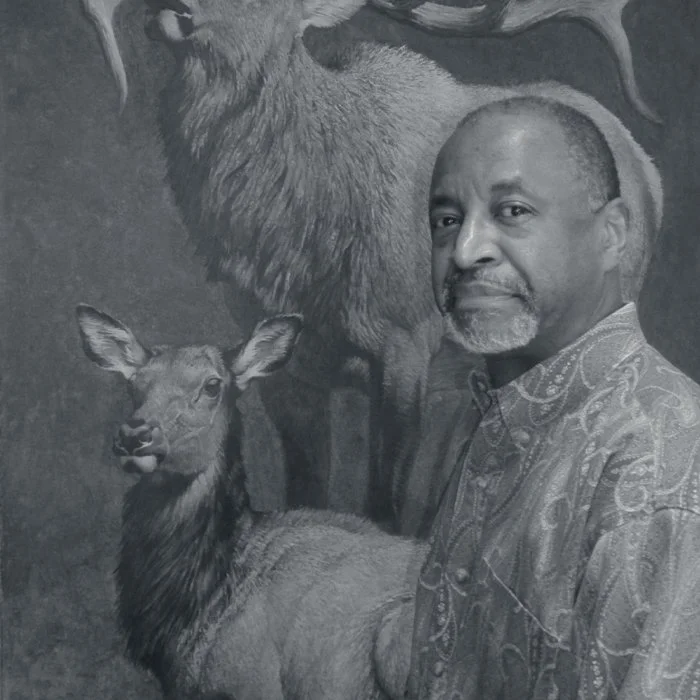
After 30-plus years of illustration and commercial art success, Ezra Tucker embarked on a fine art career, determined to create his own style of artistic beauty in both the portrayal of wildlife and historical personalities and events surrounding the settling of the American Western frontier. This 18-year journey has proved fulfilling and rewarding to his artistic vision and ambitions.
Tucker is widely admired for his paintings that portray wildlife, notably mammals, but also birds as well as historic scenes. His wildlife and historical art is reminiscent of the descriptive and narrative art produced by naturalists like Charles R. Knight and John James Audubon and reflective of many of the illustrators of the Golden Age of Illustration. While done with a nod of the head to the rich style of famous American illustrator Howard Pyle, Tucker’s art is both lyrical and specific at the same time.
-
The Black experience in the history of the American West has been untold by the historical record and is visibly absent from many of our nation’s museum collections. Tucker’s historical paintings pictorially tell the stories of people of African descent: cowboys, bronco busters, Pony Express riders, Buffalo Soldiers, Black Seminole scouts, and other Americans who shaped the North American frontier.The art of classical wildlife artists like Bob Kuhn, Carl Rungius, Edwin Landseer, Arthur Wardle, and Antoine-Louis Barye has also influenced Tucker’s style. His depictions, like theirs, pull viewers into the artwork from curiosity and their desire to be informed. He achieves this with dynamic compositions, unexpected color, lighting, and scale. Tucker’s art gives dignity and presence to each subject that he depicts. His compositions reflect the classical style of design and storytelling. His depictions are alive, animated, and appear ready to step out of two dimensions into a three-dimensional world. It is obvious from his exceptional drawing skills that his art derives from his acute knowledge gained by study of his subjects and not from a photographer’s point of view. There is a romantic appeal that he achieves with his color palette and lighting of his subjects that is familiar yet innovative.
Tucker’s background as a commercial illustrator and designer gives him the experience and almost a scientific knowledge of how to portray an iconic or bold narrative scene or portrait. His use of earth tones and warm light gives his subjects an Old Masters appeal that brings warmth to any traditional or contemporary setting when his art is displayed. His art is distinctive and reflective of natural history museum collections.
“My desire is for my art to be educational, inspirational, entertaining, and to evoke an emotional response from the viewer.”
Before Sunrise
20"×15" | Acrylic
-
I imagined Will James creating this painting of a young rider of African descent depicted in this dramatic painting, crossing the North American western plains to deliver his Mochila of mail for the Pony Express mail service. A requirement of these young daredevils were that they should weigh under 110 pounds to make it easier for their mustang ponies to maintain the speed and endurance required for their rigorous journeys. Many of this young riders were chosen because they were orphans.
One of the challenges that these young men endured on their dangerous adventures was to ride alone on a trusted pony into the night to make important deliveries. Station masters aided them in their need and haste to change to fresh mounts at relay stations along their journeys across the expansive landscapes between St. Joseph, Missouri to Sacramento, California. Riding through rugged terrain was a tremendous challenge to maintain speed and navigate safely during night rides for horse and rider.
Bull Rider
17.5"×10.5" | Acrylic
-
This painting is in the spirit of Will James and his dramatic depictions of the American Cowboy in action while at work. Bill Pickett was an American cowboy and rodeo performer inducted into the Pro Rodeo Hall of Fame. He and many other cowboys of African decent were very active in forming the lasting image we have of the cowboy at work and at play.Description text goes here
Barbara Van Cleve

Barbara Van Cleve’s heritage is rich with family history and firsthand experience. Her family’s ranch, the Lazy K Bar, was founded in 1880 on the east slopes of the Crazy Mountains near Melville, Montana.
Barbara’s passion for photography sprouted as a young girl when she received a Brownie Junior camera for her 11th birthday. Since then, it has followed her throughout her life. However, it wasn’t until 1980 that she decided to home in on her craft and dedicate her time entirely to photography. From that point on, Barbara has devoted her career to capturing the grit and beauty of the American West.
-
Her photography is more than photos of the West. It is a poetic collection of images that exhibit the wildlife, the lifestyle, the people, and the changing landscape of the West. Barbara captures the majority of her images on horseback. Barbara prefers this unique method because she can get around effortlessly and swiftly. Being on horseback also allows her some extra height. This technique gives Barbara’s photos a rare perspective that enables her to truly gift the viewer the opportunity to see the West through her eyes. Her skill she credits to her father and a humanities course. Barbara’s father taught her to notice the spectacular sights in nature, from the mirages in January to clouds of ice flakes in the snow light by the morning light.
She has had over 60 one-person shows and has been in over 100 group shows. Barbara has an extensive collection of photographs in public and private collections worldwide. Although Barbara has earned the status of ‘Famous Western Photographer,’ she still considers herself a conduit of art that allows others to see the West through her eyes.
Looking Good ©1989
16"×23" | Archival pigment print
First Saddling ©1989
14"×9.5" | Archival pigment print
Topping Off a Green One ©1989
9.5"×14" | Archival pigment print
Don Weller

As a boy Don Weller drew horses and cowboys when he wasn’t exploring with his horse along the Palouse River or over the rolling hills that surrounded his childhood home near Pullman, Washington. Graduating from Washington State University with a degree in Fine Art, he sold his horses and moved to Los Angeles where he spent decades doing graphic design and illustration. Clients includedTime Magazine, The Hollywood Bowl, The National Football League, the 1984 Olympic Games in Los Angeles, and he created five stamps for the United States Post Office. Besides illustration and graphic design, he taught school part time, three years at UCLA, where he met his wife Cha Cha, and eleven years at the Art Center School in Pasadena.
Finally, Don realized he had seen all the cement and palm trees he could stand and moved to Utah. He and Cha Cha live in rural Oakley, Utah, with Eddie the border collie, two cats, and three horses who are bred to cut. Don creates western paintings and rides the cutting horses.
Big Loop in a Bovine Sea
13"×17" | Watercolor
Careful!
18"×15" | Watercolor
Ridin’ and Ropin’
24"×24" | Oil
Rygh Westby

“I never took lessons, or painted with anybody, it just wasn’t possible”. As a self-taught artist, Rygh painted at night while using bunkhouses or barns as his studio. While working for the historic Padlock Ranch in Montana he made his first sale of a painting through a gallery. Prior to that Rygh traded paintings to pay for doctor bills, partial payments on a saddle and the like. The sale of that small painting led to the creation of a body of work over the next four decades.
Besides his family, the other motivating force in his life was the influence of men like Charlie Russell (who his great uncles in Montana knew personally), Frederic Remington, Maynard Dixon, Joe Beeler, Bill Owen, and his old compadre, Jack Swanson. “Producing art is, if nothing else, a lot of hard work. For me the motivation has to be strong enough to get me off dead center. The love of horses, cattle, and the Western landscape is what makes me tick. I am fortunate to have a wife that shares this love because it’s almost like asking her to put up with a mistress sometimes.”…
His body of work, depicting the cowboy has been created in oils, watercolors, pen and ink, and bronze. Rygh’s work has appeared on the cover of Western Horseman six times amongst exhibitions across the west. Rygh Westby also illustrated singer Ian Tyson’s book “I Never Sold My Saddle”.
I’m a Happy Guy in my Levi Britches
24"×36" | Oil
Cottonwood Canyon
18"×14" | Oil
John Willemsma
John Willemsma has had the great fortune of being able to study under some of today's greatest craftsmen, such as Don King, Dale Harwood and Chuck Stormes. Combining the knowledge he gained from them, and his study of early saddleries particularly Visalia, Hamley and Ray Holes, John brings a strong desire for high standards to each and every saddle that he builds.
2006 marks John's 30th year building high quality custom saddles. Day working on several ranches during his period, has given him an appreciation of the importance of function and fit of a custom saddle
In 1986 John opened LJ's Saddlery with a desire to build and design saddles that he felt met the needs of both working cowboy's, horsemen and women alike.
-
In 20 years John and LJ's Saddlery have gained a reputation for providing high quality Cowboy Horse Gear to customers across the United States, Canada and Europe. It is not uncommon while visiting one of the big Ranches across the west to see several cowboy's riding LJ's Saddlery saddles. It is also not uncommon to see LJ's Saddlery saddle being ridden at many of the horsemanship clinics across the United States.
From breast collars, to spur straps, and custom accessories, LJ's Saddlery has satisfied the need of these horseman and women who seek "Gear of the Highest Caliber" for 20 years.
It's John Willemsma's goal to use the knowledge passed on to him and the experience that he has gained as a horseman to create a lasting saddle that combines both function and artistic eye appeal.
For the Girls who Rode Wild Horses
Saddle by John Willemsma, Silver by Scott Hardy, Quirt by Pablo Lozano
Honoring all the women who rode bucking horses in the early 1900’s in the early days of rodeo and Wild West shows.
Stewart Williamson

Stewart’s family has ranched in the Southwest for over 120 years. Growing up working horses on their family ranch in Southeastern New Mexico gave him an early fascination for good quality, functional cowboy gear. In 2003, he attended Johny Weyerts’ engraving school in Alpine, Texas. He was quickly hooked, and he started practicing diligently and sought tips and advice from makers whose work he admired. Stewart is eternally grateful to the inspirational craftsmen--Wilson Capron, Jerry Falkner, Mike Anders, Russell Yates and Joe Spiller—who all shared their knowledge and passion of the craft with him along his career. Stewart’s goal is to make top quality pieces that are both functional and pleasing to the eye.
Stewart has enjoyed a successful career designing, building, and engraving spurs, bits, buckles, and more with a steady hand that earned him the Engraver of the Year Award in 2010 from the Academy of Western Artists, and the 2013 Adolph Bayers Spur Maker of the Year Award from the National Bit, Spur, and Saddle Collectors Association (NBSSCA).
1" Buckle and Keeper set
Fabricated from mild steel, overlayed with nickel, and hand engraved.
Kathy Wipfler

Born and raised in California, Kathy Wipfler has called Jackson, Wyoming home since 1978. Drawn to the open spaces and the spectacular scenery of the region, Wipfler finds beauty not only in the landscapes, but also in such scenes as driving cattle and harvesting hay, activities she experiences first-hand living on a working ranch. Her canvas may include a wide variety of subjects including landscapes, wildlife, domestic animals, coastal scenes or rural ranch life. However, it must be said, no matter what her chosen subject, Wipfler’s excellent ability to capture a sense of place consistently provides the viewer with an emotional attachment to that particular scene. A plein-air painter, Kathy Wipfler notes in an interview with ‘Southwest Art’ magazine, “There’s no excuse for not going to the source – if you are a landscapist, you go to the spot”. Wipfler’s confidence allows her to take advantage of her emotional response to the landscape.
“Painting is a mix of things about what is happening and responding to it. By working outdoors, I directly channel intellectual and emotional responses in color, composition, value and mood. ”
Lone Cowboy
36"×36" | Oil
Wrangle
20"×40" | Oil