
Peregrine O’Gormley | Wild at Heart
/The subject matter and materials in Peregrine O’Gormley’s sculptures reflect our world.
Southwest Art
By Bonnie Gangelhoff
Look Ma…No Trees!, bronze, ed. of 25, 7 x 5 x 10.
In the early 20th century, a cadre of artists associated with the Seattle area created a distinctive regional style that became known as the Northwest School. These artists were influenced by the unique landscape and atmosphere of the Puget Sound area. The natural setting with meandering channels and sprawling skies offered endless inspiration. The movement flourished in the 1930s ad 1940s. Today, a new generation of artists reflect their creative spirit. They are sometimes referred to as a “third-generation of the Northwest School.”
Sculptor Peregrine O’Gormley, who lives in La Conner, Washington, with a home and studio that overlooks the Puget Sound, is part of this new group of artists. The artist is known for his one-of-a-kind, painstakingly carved wood and stone sculptures. His subject matter of choice: the creatures that inhabit the world not far from his front door—falcons, owls, herons, ravens and rabbits—to name a few.
Perhaps the first thing to know about O’Gormley is that he has a profound reverence for nature. This respect is accompanied by a serious concern for the current precarious, ecological state of the natural world. For example, the artist uses only dead fallen wood for his pieces. He always takes care not to harvest living wood, and he collects much of the raw materials for his work from his immediate surroundings. O’Gormley’s menagerie is fashioned from juniper, maple, black walnut and red cedar, among others. From his wood originals, the artist also makes molds for limited bronze editions.
Last (Ochotona princeps), Mountain Hemlock (Tsuga mertensiana), Cascadian alpine fieldstone and Alaskan marble, 8.5 x 13.75 x 12.
In a piece titled MINUS 25% O’Gormley depicts a crouched falcon protecting and enclosing itself with a wing. But a portion of the falcon’s wing is missing, an entire quarter has been removed. The artist says the piece was inspired by a British Broadcasting Corporation (BBC) report about how scientists now believe we have lost 25 percent of the world’s wildlife. “Typically, my aim is to communicate with many layers of meaning,” O’Gormley says. “My hope is that one or more of the layers engage the viewer. Many of the pieces aim to communicate a narrative through metaphor that we can relate to in our own lives.”
This year has been a busy and rewarding one for the sculptor. As this story was written, O’Gormley’s playful bronze depiction of a squirrel, titled LOOK MA…NO TREES, was on view at the prestigious Western Visions Art Show + Sale at the National Museum of Wildlife Art in Jackson, Wyoming. In June, a trio of his critters was on display at the annual Prix de West Invitational Art Sale & Exhibition at the National Cowboy & Western Heritage Museum in Oklahoma City. One piece, titled LAST (OCHOTONA PRINCEPS), sold for $23,000. Ochotona is the scientific name for a pika, a small, furry mammal related to the hare and rabbit family. Some wildlife observers predict that the pika will be the first species to become extinct due to climate change in part because it is not protected under the Endangered Species Act.
Interestingly, O’Gormley’s parents named him Peregrine after a specific falcon, in a sense tying him to the natural world from birth. In ANGELORUM the artist depicts his namesake, a falcon going into a deep dive or stoop on the hunt for prey. Falcons are known as the fastest animal on the planet. When the powerful, lightning-fast avian dives, it can travel at speeds up to 240 miles per hour. “The inspiration for ANGELORUM is quite personal,” the artist says. “This is a vision of the desire to have our loved ones caught as they fall, an angel’s flight. I hesitate to use the term angel’s flight as I subscribe to no doctrine; however, the spirituality surrounding death has become visceral for me in the wake of my father’s passing.”
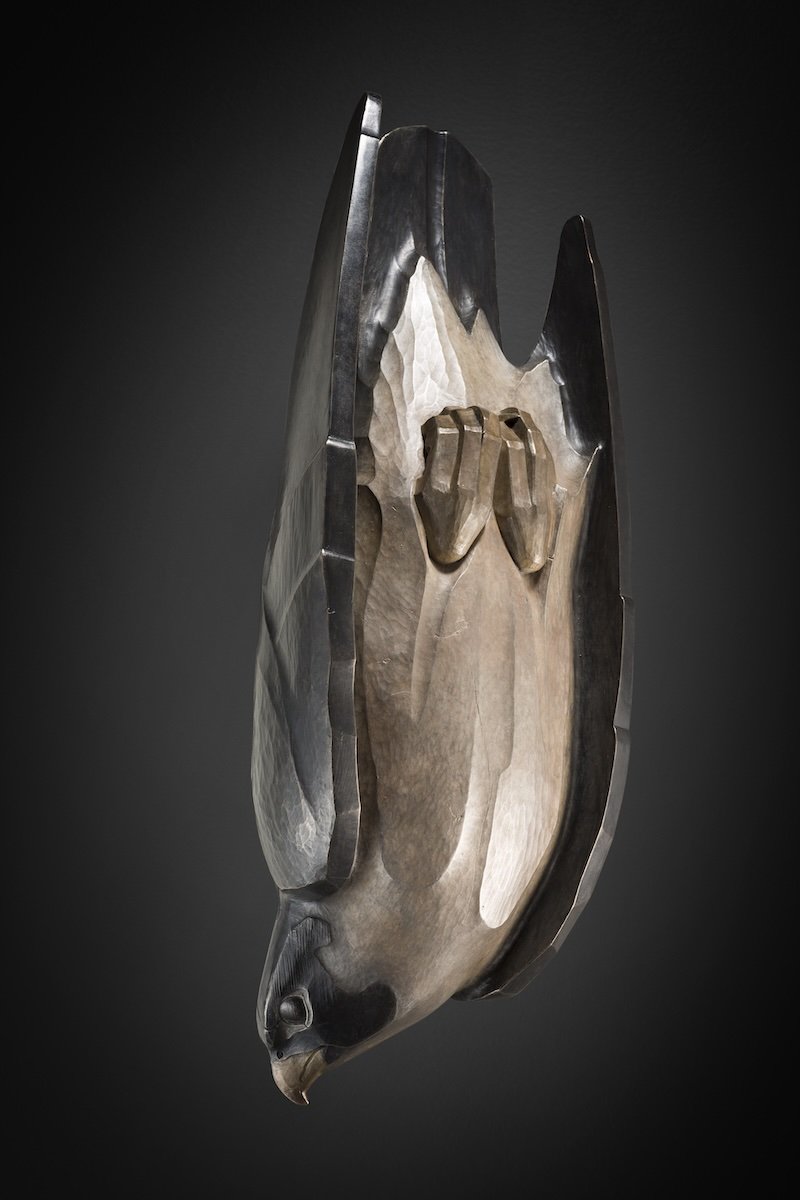
Angelorum, bronze, ed. of 9, 11 x 8 x 21.
O’Gormley says that ideas come to him, inspiring the imagery and filling the need to create physical forms. He adds, “The natural world provides limitless subject matter, but the ideas are more about human experience than the subjects themselves.”
Sue Simpson, owner of Simpson Gallagher Gallery in Cody, Wyoming, which represents O’Gormley, first met the artist in 2021 at an exhibition at the Woolaroc Museum & Wildlife Preserve. At the show Simpson purchased O’Gormley’s piece WIDE OPEN, a sculpture featuring four baby birds with their mouths open waiting to be fed. The piece displays the lighter side of the artist’s oeuvre.
Wide Open, stainless steel, ed. of 10, .75 x 1.5 x 2.
“I love the piece for its whimsy, its design and the way it calls out to be touched,” Simpson says. “Peregrine’s work makes me smile and think—sometimes because it is so esoteric and sometimes because it is so universal. I like that I don’t have to wonder if a sculpture is “right.” His pieces are always anatomically correct while at the same time filled with the spirit of the animal with a nod to the legacy of animal art.”
The World Was Flat…Until…, dendritic soapstone and basalt, 4.25 x 7.75 x 7.25.
If readers peruse O’Gormley’s biography on his website, they quickly learn he had a unique and auspicious introduction into the world—the artist was born in a green pickup truck on Route 66 in front of a gun shop. Despite his arrival while “on the road” he spent the first 18 years of his life in one place. The artist grew up in the mountains of Central New Mexico in the Juan Tomas Valley and attended school in the nearby town of Tijeras. His childhood was idyllic. The young O’Gormley lived at an elevation of 7,200 feet, amid 40 acres of grazing land overflowing with abundant wildlife such as lizards, snakes, squirrels, coyotes and deer. His days were filled with explorations and adventures in the surrounding woods.
It is no surprise that O’Gormley would become an avid student of the plants, animals and fossils that were part of his daily life. “The environment was safe and infinitely inviting—full of fossils, climbing trees, arroyos to slide in, mud to muck in, birds and botany to observe, scents and sounds of the forest and fields to absorb. And quiet, so much quiet,” O’Gormley recalls.
Early on, his father instilled in him a respect for nature while also expressing a concern for the earth’s well-being. Sculpting, carving, drawing and making things with his hands began when he was very young, the artist says. Both his father and grandfather were sculptors, and they offered encouragement to their budding young artist. In fact, O’Gormley is fond of saying his interest in nature and art was “osmosed through immersion.”
Ally, juniper on juniper snag (windfall), 73 x 43 x 29.
He took a few art classes in high school, but when it came time for college he chose to major in biology at Colorado College. In his spare moments he sculpted, but there was never enough time. He also met his future wife at college and after graduation the couple traveled extensively before settling down in Washington in 2007. For a brief stint, O’Gormley worked at a day job as a lead carpenter for a high-end residential construction company. He sculpted in his free time. In 2008 he gave up his day job and devoted himself full time to his art, participating that same year in his first show, Art in the Park in Loveland, Colorado. Over the ensuing years, awards, gallery representation and invitations to prestigious shows continued to come his way.
Trajectory Blue, yew, carved 14k gold, OSHA blue oil paint, 2 x 5 x 3.
Bill Rey, owner of Colorado-based Claggett/Rey Gallery, which represents the artist, says O’Gormley brings a unique take on Mother Nature to the art world, not a typical mainstream view. “Most of his creations are metaphors for a deeper reflection of his life while also focusing on the natural world’s amazing critters trying to survive and thrive among humans,” explains Rey. “You can tell there is empathy and study about what he chooses to honor through his work.”
Currently, O’Gormley says he is between pieces—ideas are brewing and marinating. When he returns to the actual creation of new works, he plans to focus on pieces for the 2026 Prix de West exhibition. But don’t expect to get any clues about these artworks before the show opens.
“I never communicate about a work-in-progress, only after it is completed,” O’Gormley says. “Pieces in progress possess a unique fragility and vulnerability akin to birthing.”
When asked about his future goals, the artist has a ready answer. “Museum and gallery shows are critical for exposure and sales. However, my primary motivation is personal,” O’Gormley shares. “I’ve been carving my internal landscape for decades, and there are so many pieces pulling me forward. My sincere hope and my goals are to continue working and to be fortunate enough to bring the works to fruition.”
Bonnie Gangelhoff is a Colorado-based writer and former senior editor of Southwest Art.